

We rented a car three times in South Korea, once on Jeju and twice after landing in Seoul. With two small children, it made it much easier to get to museums, cafés and places we would have struggled to reach otherwise. We also had to work out child seats, lunch stops and parking. Here’s what we learned.
Driving in Korea took some getting used to. Drivers sometimes changed lanes without signalling, a green light didn’t always let us turn left, and once someone parked across our car. We found a way out of that one. Below I cover the licence you need, the navigation app that worked for us, fuel, tolls and how we returned the car at the airport.
💡 We booked through Discover Cars for all three rentals. I like having someone to contact if there’s a problem. Their optional damage cover also worked out cheaper for us than cover at the rental counter.
Is it worth renting a car in South Korea?
I’d rent a car if you want to explore beyond Seoul and Busan. We could fit a museum, a walk and a café into one day without working around bus times. With kids, I’d do the same again on Jeju. Our Jeju itinerary shows the places we reached by car.
Martin reckons an experienced driver will get used to it, though it might be a lot for a beginner. Traffic often felt slower and smoother than at home, but drivers sometimes moved into our lane without warning or didn’t let us merge. Leaving extra space and using a good navigation app helped.
Rent for the whole trip or just part of it?
I’d use the subway in central Seoul. It saves hunting for parking every time you stop. A rental was most useful for day trips outside the city and for Jeju, where we wanted to set our own pace. If you start with a few days in Seoul, collect the car when you’re ready to leave the city.
For a longer mainland trip, compare driving all the way with taking trains between cities and renting for day trips. Factor in your group size, luggage and stops off the main route. If you want to drop the car at a different branch, confirm that the booking allows it and check the one-way fee. We rented separately on Jeju. Check ferry restrictions before planning to take any rental car onto a ferry.
Before you book a rental car in Korea
- Get the right International Driving Permit (IDP) and pack your original domestic licence and passport. A friend was refused a car on Jeju because of her permit.
- Download Naver Map and set it up before leaving home.
- Read up on left turns, junction priority and lane changes before getting behind the wheel.
Which International Driving Permit do you need for South Korea?
Martin got his permit before we left Czechia, and the rental company checked it at pickup. A friend was refused a car on Jeju because of her permit. Get the paperwork sorted before booking and ask the rental company which convention it accepts for your booking.
Under Article 96 of South Korea’s Road Traffic Act, recognised IDPs include those issued under the 1949 Geneva Convention or the 1968 Vienna Convention. The form you can obtain depends on the country that issued your driving licence. Bring the original, valid IDP, your original domestic licence and your passport. The Korean law allows driving for up to one year from entry, subject to the permit’s own validity. Make sure your documents cover the entire rental.
For a Czech licence, the Czech guidance directs travellers to the 1949 Geneva permit for South Korea. If your licence was issued elsewhere, check your issuer’s guidance for South Korea and confirm the convention with the rental company before paying. Use the official Czech application process if you hold a Czech licence, or the authorised issuer in your country and bring the physical permit to the counter. Travellers with a UK licence should get the 1949 IDP and carry their UK licence as well.
Booking through Discover Cars and what to check
We booked all three rentals through Discover Cars. On the mainland, we picked the cheaper WheeGo option and were pleasantly surprised at pickup. Look beyond the headline price and check the pickup procedure, fuel policy, child seats and what’s prepaid. The payment was the one part of an otherwise smooth pickup that nearly went wrong for us.
We use Discover Cars because there’s someone to contact if an issue comes up with the supplier. Support is available around the clock. I also like being able to cancel up to 48 hours before pickup when the booking terms allow it. That’s handy if your plans are still moving around.
Minimum age, driving experience and additional drivers
A valid IDP is one part of the paperwork. A minimum age of 21 and a licence held for at least one year are common, but the rules can vary by rental company and car category. Enter the driver’s actual age and read the conditions for that car, especially if you need a larger family vehicle.
If you’ll share the driving, add the second driver to the contract. Both drivers should come to pickup with their documents and meet the company’s requirements. Check any additional-driver fee and make sure the second driver is included in the rental’s cover.
Payment cards and deposits
Card rules vary by supplier. Lotte lists both debit and credit cards, while National on Jeju requires a credit card in the renter’s name. Check the card type, cardholder name and deposit for your exact booking on Discover Cars before paying.
Discover Cars Full Coverage
We use Discover Cars’ Full Coverage because it has worked out much cheaper for us than buying extra damage cover at the counter. It works by reimbursing eligible charges under its terms. You pay the rental company first and then submit a claim to Discover Cars. The rental company may still place a hold on your card for the deposit.
Check the excess, exclusions, claims procedure and any charge for the time the car is out of service. A supplier’s own cover and third-party reimbursement work differently. For example, Jeju Angel lists separate terms for its different cover options. Read the details behind labels such as “full insurance.”
🚗 Keep your booking confirmation and damage-cover terms handy at pickup.
Check your excess, deposit and claims procedure before driving away.
Renting a car in Seoul: pickup and return
Alamo in Seoul: six days and a free shuttle
On one trip we had an Alamo rental from Seoul Incheon Airport booked through Discover Cars. A free shuttle took us to the rental office. The car cost ₩462,000 for six days, and each of our two child seats cost ₩66,000. We paid ₩594,000 altogether.
Picking up at the airport after landing
For our nine-day WheeGo rental, we followed the instructions to a meeting point in the arrivals hall and sent a photo over WhatsApp so they could find us. Two staff members were there in under a minute. They sat with us and handled the paperwork, including the licence check, right there in the terminal.
We nearly paid the rental charge twice
While doing the paperwork, the staff tried to charge the rental again. Martin knew we had already paid and showed the payment confirmation. They sorted it out and we were charged once. Keep your booking confirmation and payment breakdown handy so you can see what’s prepaid and what’s due at pickup.
They took us straight to the car in the airport car park. We photographed it while they helped with the child seats and luggage. I’d never had that level of service from a car rental before. They explained how to leave the car park and how to return the car. Finding the right exit took a moment, but the barrier opened automatically and we drove out without paying.
Child seats: a Cybex and a booster
WheeGo supplied a Cybex seat for our younger boy and a booster for our older one, and helped install both. The two seats cost just under CZK 4,000 for nine days. Book seats ahead, give the children’s heights and weights, and ask how the seats attach and what they cost for the whole rental. For food, strollers and day trips, see our South Korea with kids guide.
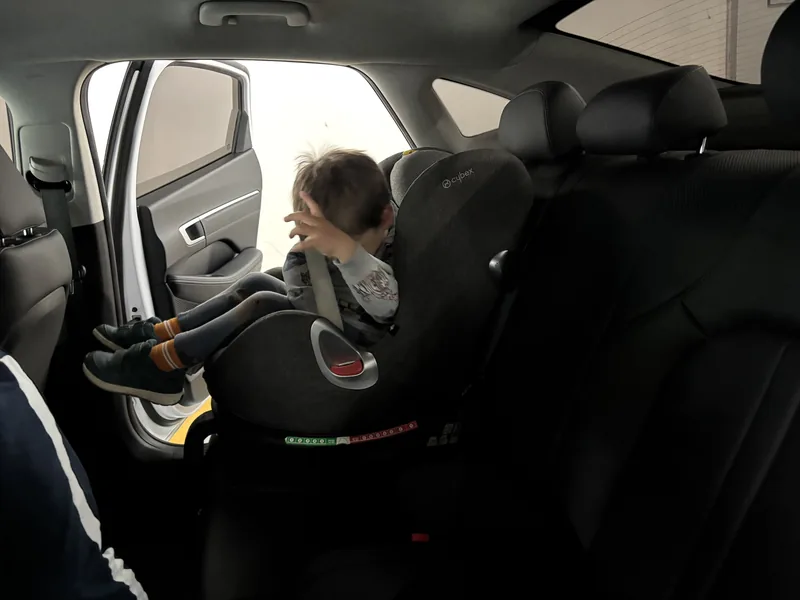
Returning the car with the same fuel level
Our car had a same-to-same fuel policy. We photographed the gauge at pickup and used it as a guide at the last fuel stop. We ended up leaving a little extra in the tank. With this policy, match the level shown at pickup.
Returning the car at the airport
We were told to drive to the terminal car park, park around section 1301 and message when we arrived. We found a space and the employee arrived in about a minute. He photographed and checked the car and took it back. We were done in under ten minutes.
Having someone meet us right by the terminal was lovely with kids and luggage. Follow your own supplier’s return instructions and confirm your airport and terminal. Seoul is served by both Incheon (ICN) and Gimpo (GMP).
Renting a car on Jeju: free shuttle, lounge and upgrade
We booked our Jeju rental through Discover Cars too. A free shuttle took us a few minutes from the airport to the office. There was a lounge with a sofa and café while Martin did the paperwork, and we got a free upgrade. Our The Safe Rent A Car booking cost ₩300,000 for six days, plus ₩60,000 per child seat. We paid ₩420,000 in total, which I thought was excellent for nearly a week with the family.

Driving on Jeju felt more intense than on the mainland. We kept expecting someone to bump us and it finally happened in a car park. I’d still rent again for a trip mixing beaches, museums, cafés and the interior. Sort out your cover and documents beforehand, especially the IDP.
Jeju without a car: guided day trips
You can book a day trip with transport if you’d rather leave the driving to someone else. Check the pickup point before booking. Jeju City is on the north coast and Jungmun and Seogwipo are in the south. Below are three tour options. We drove ourselves and set out our route in the Jeju itinerary.
🚗 I’d book through Discover Cars, as we did, and confirm the pickup terms for your chosen car.
Navigation in Korea: why I use Naver Map
Naver Map worked really well for driving. At some complex junctions, the road has coloured guide lines, often pink or green. Naver showed the same colours on screen, which made it easier to follow the right lane than relying on a spoken instruction alone.
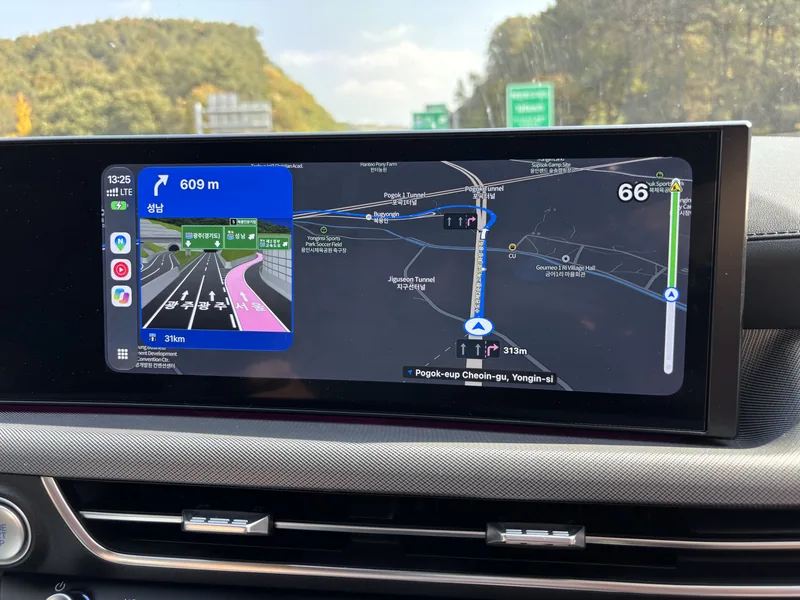
It also showed junction layouts, speed cameras and our average speed in monitored sections. We could see the next service area, which helped with the kids. It works with Apple CarPlay. Sign in and save a few destinations before travelling so you can find the first address as soon as you pick up the car.
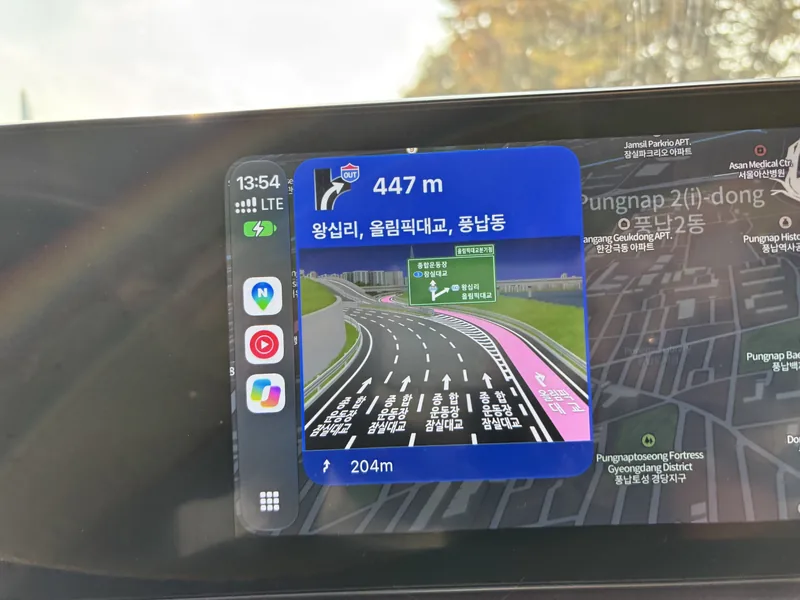
Bring a phone mount if you’ll navigate from your phone. Check that it fits with the case on and place it where it won’t block your view. A charging cable is useful on longer drives.
🗺️ For route ideas, see our Jeju itinerary and DMZ guide.
Driving in South Korea: what surprised us
South Korea drives on the right. We generally found speeds fairly low in towns and on smaller roads. On clear, straight stretches we saw some people going much faster. We stuck to the posted limits because there were speed cameras everywhere.
Indicators and slow cars in the left lane
We saw drivers change lanes without indicating, pull in front of us or leave us less room to merge than we expected. We also came across slower cars staying in the left lane. Give people space and make lane changes early when you can.
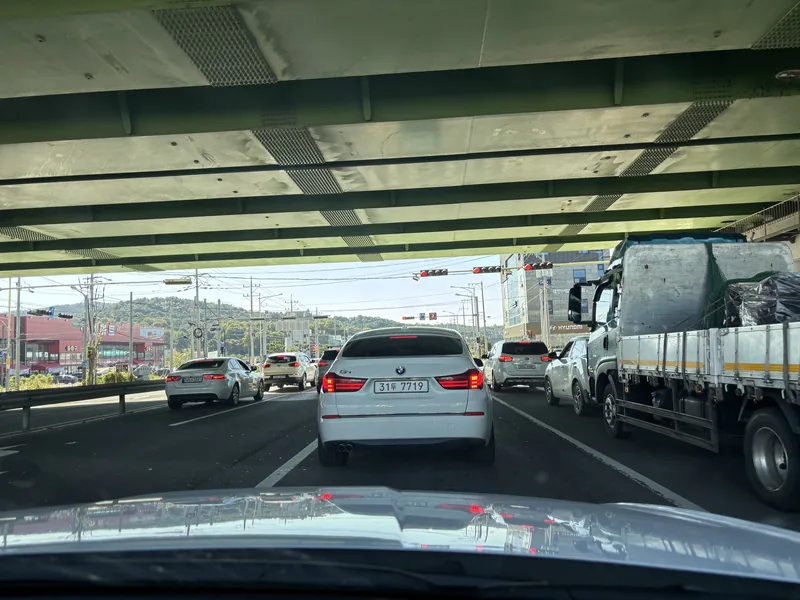
Turning left and the green arrow
A circular green light alone doesn’t automatically let you turn left. Where a green arrow controls the turn, wait for it. At a junction marked 비보호, you may turn left on green after yielding to oncoming traffic and pedestrians. The VisitKorea driving guide explains the signs and signals.
Turning right on red and watching for crossings
If a right turn on red is permitted and there’s no separate right-turn signal, come to a complete stop before the stop line or crossing. Proceed only when it’s safe and you can yield to other traffic and pedestrians. Where there’s a separate right-turn signal, wait for its green arrow.
Look for a crossing just around the corner. Yield to people who are crossing or about to cross. If you’re unsure, wait. KBS World explains how the rule changes when there’s a dedicated right-turn signal.
Who has priority at junctions and flashing lights?
At an uncontrolled junction, yield to vehicles already in the junction. If you’re coming from a narrower road, yield to traffic on the wider one. When vehicles arrive together on equivalent roads, yield to the vehicle on your right. When turning left, yield to vehicles going straight or turning right. See the Korean traffic rules for details.
A flashing red light means stop at the stop line or crossing, then proceed once you’ve checked traffic and yielded. At flashing amber, slow down and proceed with caution. A white stop line marks where to stop when a signal or sign requires it. See the KoROAD handbook.
Speed cameras, speed bumps and lane changes
Naver warned us about cameras and showed our average speed in monitored sections. We saw plenty of speed bumps, as well as painted markings that looked like bumps from a distance. We even saw mock police officers and police cars, and real police cars with their lights on when they weren’t in a hurry.
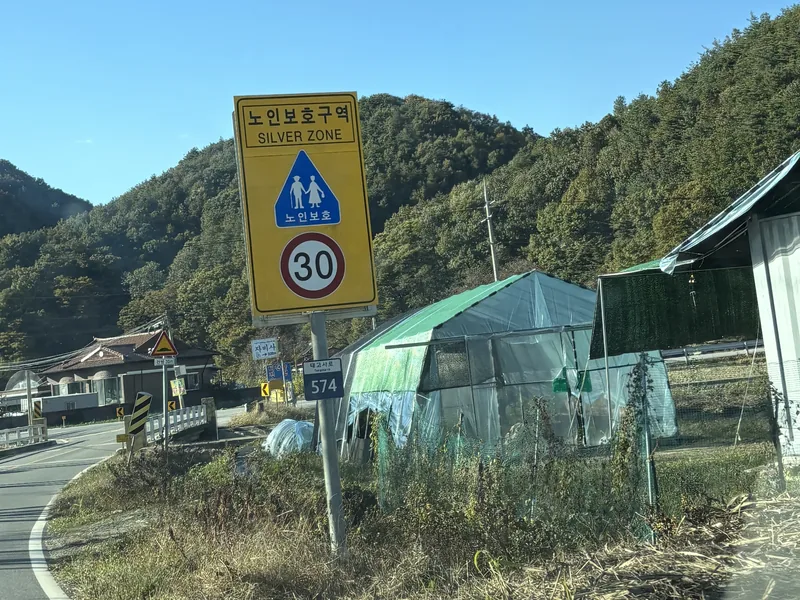
Pick your lane early before tunnels and bridges. Stay in your lane across solid white lines even if your app suggests a different route. Naver’s coloured guides were useful where roads split and we needed to move over in advance.

Bus lanes, seat belts and child restraints
Follow the signs and operating hours for blue-marked bus lanes. You may also see blue markings for Hi-Pass near a toll plaza, or coloured guide lines at junctions. Check what the marking is for before changing lanes.
Everyone must wear a seat belt, including in the back. Children under six must use a child restraint. Older children may still need a suitable booster for the belt to fit properly. Choose a restraint for the child’s height and weight and check it fits the rental car. See the Korean legal guide for the requirements.
Parking in Korea and what to do if you’re blocked in
Watch the yellow markings by the kerb. A broken yellow line prohibits parking, a single solid yellow line restricts stopping and parking subject to any posted exceptions, and a double yellow line prohibits both at all times. See the KoROAD handbook. We saw cars parked in all sorts of places, sometimes two deep. Follow the markings and signs when choosing a spot.
Drivers often leave a phone number on the dashboard so you can reach them if they’ve blocked you in. When it happened to us, I asked a woman on the street if she could call from her Korean number. She knew exactly where to look. The owner came out, moved the car and we were on our way.
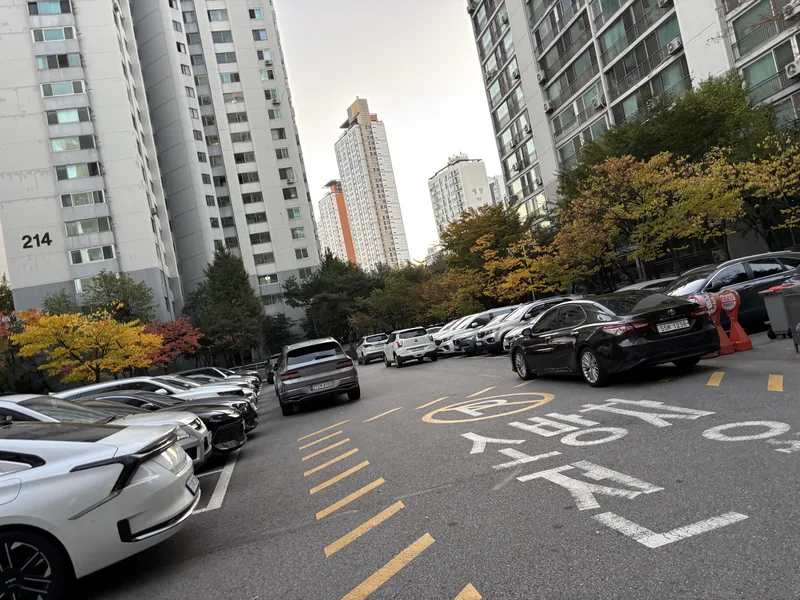
Some automated car parks may reject a foreign card even if it works elsewhere. Check payment options and how to contact the attendant before parking. Our card worked at every fuel station we used. See VisitKorea’s parking advice for more detail.
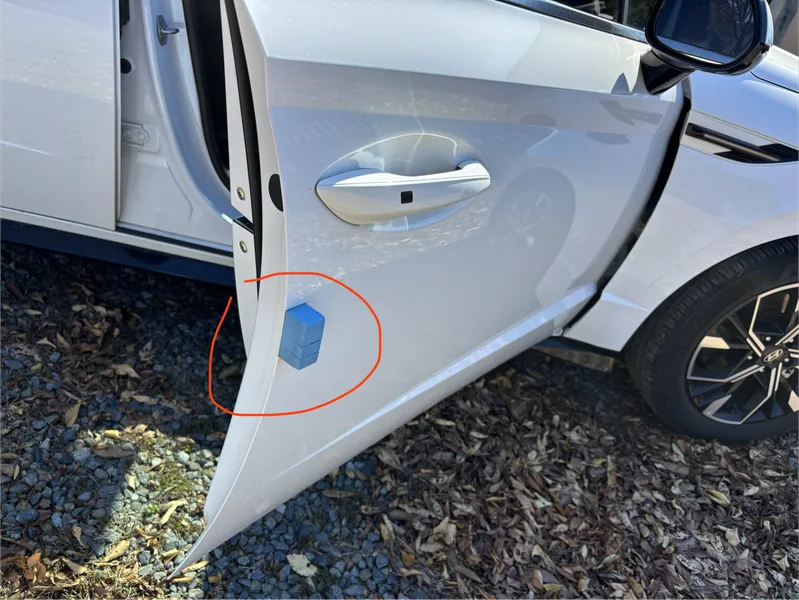
We also noticed little foam blocks stuck on car doors. They help prevent dents when you open the door in a tight spot. I thought they were clever, especially after our own little car-park bump on Jeju.
Motorway tolls in Korea: ask about Hi-Pass
Ask at pickup whether your car has Hi-Pass, Korea’s electronic toll system. We had it and the supplier charged us for the tolls afterwards. Ask how to tell whether the device is active, how tolls are billed and whether any admin fee applies.
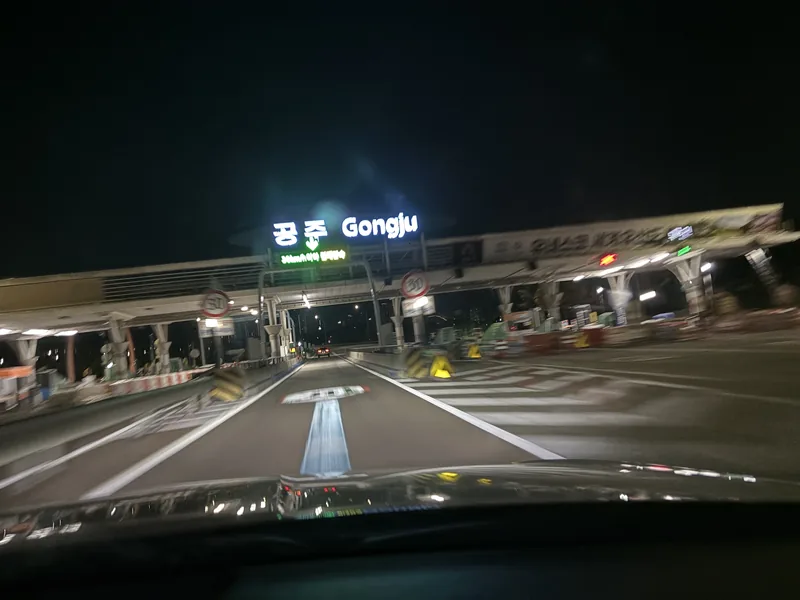
We followed the blue markings for Hi-Pass, often on the left. Follow the signs and speed limit at each toll plaza. Naver showed estimated tolls as we planned our route, and the rental company billed the actual crossings. Use a regular payment lane if your car has no active Hi-Pass.

Paying a toll without Hi-Pass
Choose a regular payment lane. On roads with a ticket system, take a ticket at entry and pay at exit. Other toll booths collect a fixed fee. See the VisitKorea toll guide and ask at pickup what payment method to use.
If you enter the wrong lane, keep moving safely. Avoid braking suddenly or reversing at the toll plaza. Note the place and approximate time and contact your rental company so they can identify the unpaid toll and explain any admin charge.
Motorway service areas and food stops
We planned food and fuel stops because the next service area wasn’t always around the corner. Naver showed us where it was. I’d stop for a meal too. Some service areas had a shared dining room surrounded by food stalls, so one person could order soup, someone else bibimbap and another pizza.
Return the plates and bowls to the stall they came from. We picked food from several counters and then had to sort everything again after lunch. Easy once you know, and a good setup when everyone wants something different.
Fuel stations and petrol prices
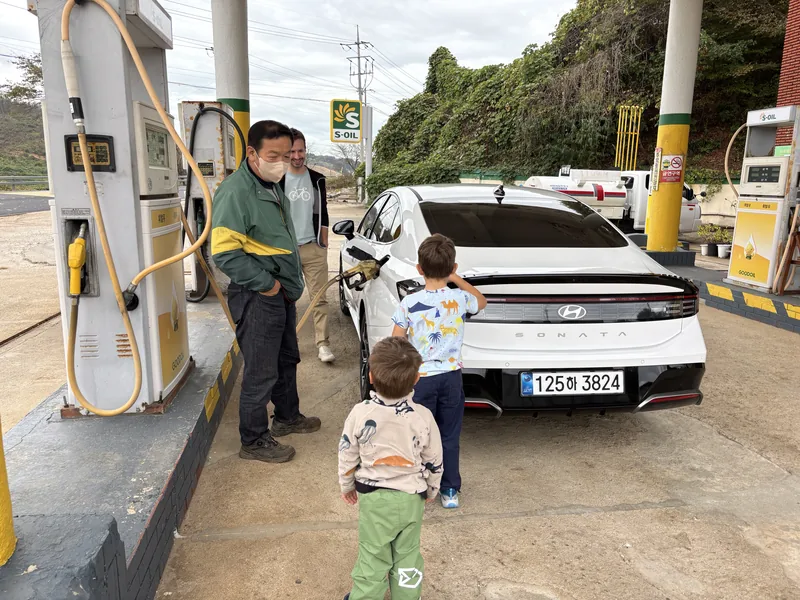
We paid about ₩1,880 per litre for petrol, which felt inexpensive to us. Staff often filled the car for us, or we asked for help when the pump wasn’t clear. Our card worked every time we filled up. Ask staff before you start if you’re unsure about the fuel type or how the machine works.
Accidents, damage and breakdowns
We had a small parking bump on Jeju, so I’d save the rental company’s number, roadside assistance number and booking reference before setting off. Call the company straight away after a breakdown or damage and agree on the next step. Get their approval before arranging a tow or repair.
- Get to safety and call for help. Stop and secure the scene if it’s safe to do so. Call 119 for an ambulance and 112 for police.
- Tell the rental company straight away. Give your location, explain what happened and say whether anyone is hurt. Ask about police, roadside assistance and whether you can still drive the car.
- Document what happened if it’s safe. Photograph the damage, surroundings and number plates, and note the other party’s contacts. Keep any police report and correspondence with the rental company.
- Keep the claims paperwork. Ask for an itemised bill, receipts and relevant repair documents. If you bought Full Coverage, follow the claim instructions and deadlines in the terms.
The 1330 tourist helpline can assist with interpretation. Save 112 for police and 119 for emergency medical help in your phone. Ask at pickup whether the rental company needs a police report even for minor damage.
South Korea car rental FAQ
What driving documents do I need in South Korea?
Bring your original domestic licence, passport and a valid physical IDP. Korean law recognises the 1949 Geneva and 1968 Vienna conventions. Check your issuing country and rental company for the right format. UK and Czech travellers should obtain the 1949 permit.
Can I rent a car in Korea with a debit card?
It depends on the supplier and booking. Lotte lists debit and credit cards, while National on Jeju requires a credit card in the renter’s name. Check card and deposit rules before paying.
Which navigation app should I use in Korea?
Naver Map worked well for us, with colour-coded lane guidance, speed camera alerts and service area information. It also supports Apple CarPlay.
Do rental cars in Korea have Hi-Pass?
Some do. Confirm that the unit is active and ask how tolls are billed. Our rental company charged us afterwards.
Can I rent child car seats?
We booked paid seats from our rental company: a Cybex for our younger child and a booster for our older one. Confirm availability and suitability for your children’s height and weight.
More South Korea guides: South Korea with kids · Jeju itinerary · DMZ from Seoul
I started travelling after finishing secondary school in 2005. Since then, I have studied in New Zealand and lived in Malta, Madeira, Brittany and Porto. I speak English and French, some Portuguese and very basic Chinese. I travel with hand luggage only and used to stay through Couchsurfing; these days, I use HomeExchange. I travel with my two children. Professionally, I am an agile coach, and I also perform improvisational theatre. Read more about me and my work as a Czech travel influencer.