

Before you start planning your Portugal trip, here is how to say thank you: obrigada if you are a woman, obrigado if you are a man (roughly pronounced oh-bree-GAH-doo). Consider an evening cruise with an open bar, and make sure you get beyond the city too. Sintra and Cascais are brilliant.
More from Portugal: São Miguel, Azores
Before your trip to Lisbon
- Book a Sintra and Cabo da Roca tour. You can save with code CESTUJZABABKU5, valid only in the app downloaded through this link. Check the cancellation policy and free cancellation deadline for your chosen tour.
Flights to Lisbon
If you are flying from Prague, TAP Air Portugal and easyJet operate direct flights to Lisbon (Lisboa in Portuguese). With easyJet in particular, it pays to book ahead. Smartwings has also joined the route, flying on Mondays, Wednesdays and Fridays in the 2026/2027 winter timetable. Flight days and prices vary throughout the year, so compare departures from Vienna too. You can often find cheaper fares outside peak season. Lisbon can be lovely in winter as well, just expect changeable weather and wind off the Atlantic.
If flying from Vienna is an option for you, compare fares from there too. For a first visit, allow 3 to 4 days. If you have already visited Lisbon a few times, consider hiring a car and exploring rural Portugal for its authentic atmosphere and good prices. We did just that in Peniche and had a great time.
When to visit Lisbon and what to watch out for
For me, spring and autumn are best: you can comfortably explore the city on foot. In summer, expect heat, strong sunshine and queues. Winter is usually milder than back home in Czechia, but rain and wind from the Atlantic are still part of the deal.
- Shoes: Lisbon is hilly, and its pale stone pavements get slippery, especially after rain. Bring shoes with a good grip.
- Tram 28: for a ride, go early in the morning or later in the afternoon. It gets packed during the day, so keep an eye on your belongings in the crowds.
- Reservations: book a timed ticket ahead, especially for Pena Palace in Sintra. In peak season, reserve the most popular sights in Belém too.
- Suitcases and pushchairs: expect steps and cobblestones in Alfama. To avoid hauling luggage uphill, stay near the metro in Baixa, Chiado or Avenidas Novas.

Getting from Lisbon Airport to the city centre
The easiest option is the red metro line from Aeroporto station. For the historic centre, you will usually change once, for example at Alameda; allow around 30 to 40 minutes depending on your destination. The metro runs daily from 6:30 am to 1 am. A Carris/Metro ticket costs €1.90 and is valid for 60 minutes; the Navegante occasional card costs €0.50. Zapping credit works out cheaper at €1.72 per metro journey, or you can tap a contactless bank card at the gates for €1.92. See Lisbon Metro for current fares.
At night, a taxi is not your only option. Night bus 208 serves the airport on its route between Oriente station and Cais do Sodré, passing Praça do Comércio, Praça da Figueira and other central stops. Services are not frequent, so check the departure time before travelling. With bulky luggage or a late arrival, a taxi, Bolt or Uber may be more comfortable. Check the fare before confirming your ride.
Public transport in Lisbon
You can walk around central Lisbon, but the metro (four lines), buses, trains and trams are useful for sights further out.
Tram 28 is hugely popular and passes many of Lisbon’s best-known spots. A tourist service with red trams follows a similar route, but charges a separate fare. You can also book a guided tram ride combined with a walking tour.

For a weekend, choose between a Navegante occasional card loaded with zapping credit and a 24-hour ticket. The card itself costs €0.50, a metro journey using zapping costs €1.72, and a 24-hour Carris/Metro ticket costs €7.25. The €11.40 Carris/Metro/CP option also includes urban trains, making it useful for a day trip to Sintra or Cascais. Each passenger needs their own card.
Lisboa Card or Navegante?
Choose Navegante with zapping credit if you mainly plan to walk and only need occasional rides. Pick a 24-hour ticket for a day with lots of public transport. The Lisboa Card combines unlimited public transport, trains to Sintra and Cascais, and admission or discounts at more than 50 sights and attractions. Since April 2026, adult cards cost €31 for 24 hours, €51 for 48 hours and €62 for 72 hours. Before buying, add up transport and admission to the places you actually want to visit. For a few rides and plenty of walking, Navegante is usually enough. Check the current inclusions on the Lisboa Card website.
Important for Belém: you need a date and time reservation for both Belém Tower and Jerónimos Monastery, even with a Lisboa Card. Exchange your voucher for the physical card first: you need its number to make a reservation, and spaces must be available for cardholders. Buying the card alone does not guarantee entry. Read the reservation rules.
Take closures into account when deciding whether to buy the card. Museu Nacional do Azulejo and Museu Nacional de Arte Antiga, for example, are temporarily closed for renovation, and the Santa Justa lift is out of service too. Only count open sights you can realistically fit into your trip when calculating savings. If Belém is your main priority, read the reservation conditions above first.
Lisbon’s funiculars and lifts: elevadores
Lisbon has three well-known historic funiculars, Glória, Bica and Lavra, as well as the vertical Elevador de Santa Justa. After the Glória accident, all four were temporarily taken out of service for safety reasons. The newer Graça funicular is running, but check the latest status on the Carris website before you travel. Santa Justa is close to Rossio and normally connects the lower city with the Carmo area. You can also reach its upper walkway and views on foot from the upper part of town, so a closure does not have to mean missing the view.

Lisbon’s elevadores help locals avoid the steep uphill walk. You can find more information, including timetables (horários), on the website of Lisbon’s transport operator, Carris.
Restaurants in Lisbon and Portuguese food
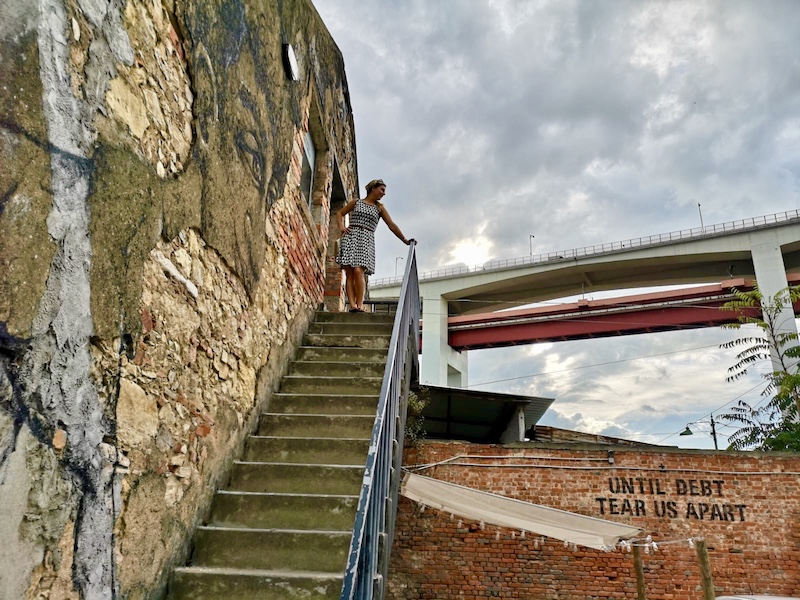
Take a tram to Calvário, then walk the short distance to LX Factory, a former factory now filled with hipster cafés, restaurants and little shops.
Supermarket groceries are not much more expensive than in Czechia. Fruit can even be cheaper, particularly tropical fruit.
If you fancy eating out, look for lunch menus, which tend to be better value than dinner. There is usually a choice of several dishes, often including fish. During our visit, Portuguese locals advised us not to order fish on Mondays, when restaurants were still using up their weekend supplies.
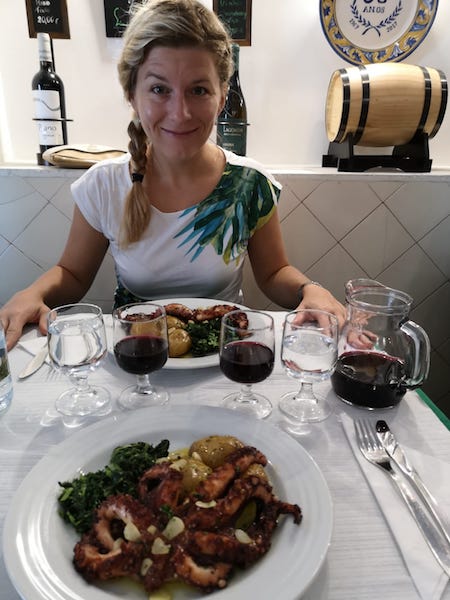
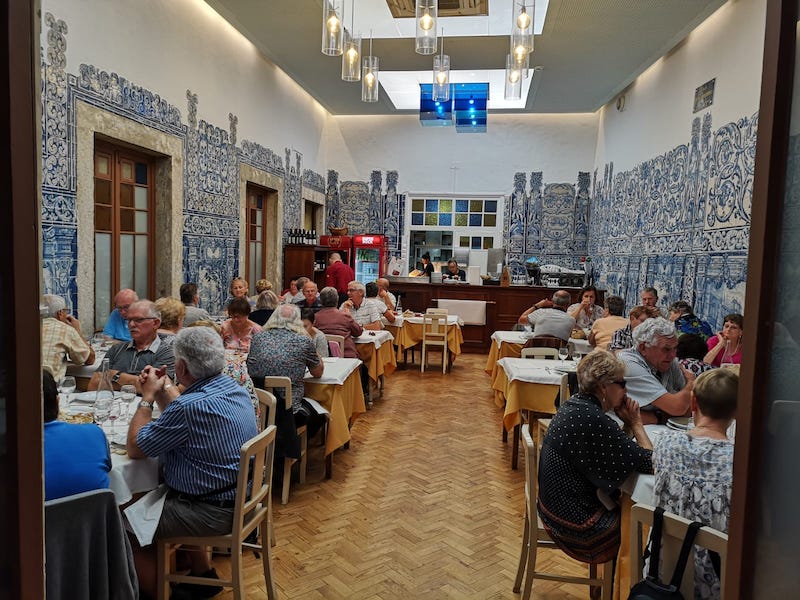
A Portuguese speciality is bacalhau (cod), prepared in all sorts of ways. For a taste of Portuguese cooking, head to Casa do Alentejo, a building near the centre where you can also pick up information about the Alentejo region. There is a bar and restaurant inside; I recommend ordering a selection of smaller dishes to share. Two very good dishes are punheta de bacalhau, a chickpea and cod salad, and porco com amêijoas à alentejana, pork with clams and fried potato cubes.
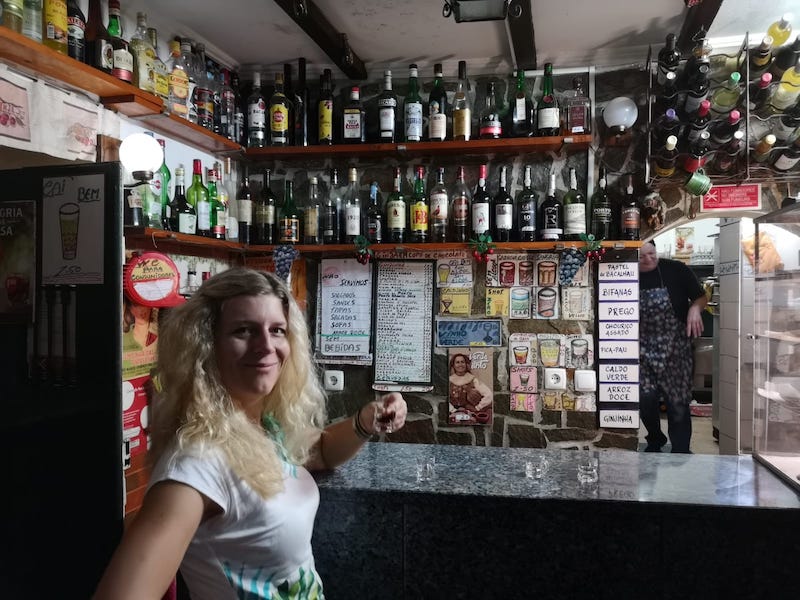
For a proper Lisbon stop on your way to dinner, try a bar specialising in sour cherry liqueur, ginjinha. There are several around Rossio and along Rua das Portas de Santo Antão. A shot cost €2.50 when we visited; current prices may differ.
In the evening, beer (cerveja) is the usual order in Bairro Alto. Portugal’s two big brands are Sagres and Super Bock. Beer is often served in 0.2-litre glasses; half-litres are less common. I find local beer sweeter than Czech beer. If sangria is more your thing, Lisbon will not disappoint either.
You can get good coffee almost anywhere. Lisbon is full of pastelarias, cafés serving strong espresso alongside pastries, cakes and sandwiches. With your coffee, definitely try a traditional pastel de nata, a crisp puff-pastry tart filled with custard. Prices vary a lot between an ordinary neighbourhood pastelaria and somewhere in the tourist centre, so do not treat prices in older travel stories as fixed.
Where to stay in Lisbon
Choose your area: Baixa and Chiado are the easiest bases for a first visit because you can walk to most central sights. Alfama has the strongest old Lisbon atmosphere, but also hills, steps and trickier access with luggage. Choose Bairro Alto or Cais do Sodré for bars and nightlife rather than peaceful sleep. For quieter nights, look at Estrela, Lapa or Avenidas Novas. Compare Lisbon accommodation.
I recommend Alfama: it is within walking distance of the centre and is packed with narrow lanes, restaurants and bars. We found a really cosy place to stay there, 36for2. It still operates and has a great location, but it is adults-only. Add Lisbon’s tourist tax to your accommodation budget: €4 per person aged 13 and over, per night, charged for a maximum of seven nights.
Accommodation for different types of trip
- First visit, with everything close by: Hotel da Baixa is near Rossio and Baixa-Chiado metro station. It also has family rooms, and guest reviews particularly praise its location.
- Quieter nights, families or a pool: Lumen Hotel & The Lisbon Light Show is in Avenidas Novas, away from the noisiest bar streets. It has family rooms and an outdoor pool.
- Alfama atmosphere for two: 36for2, where we stayed, is adults-only.
- Nightlife: look around Bairro Alto or Cais do Sodré, but search reviews for mentions of noise before booking. Chiado keeps you close to the action with a better chance of a quieter night.
Lisbon accommodation map
Use the map to compare hotels and apartments for your dates. Open the accommodation map in a new tab. In Lisbon, look beyond the price: check the distance to the metro and how much climbing is involved between your accommodation and the centre.

Or try something different and sleep on a boat. Depending on your dates, it may cost less than a central hotel, but expect less space, some movement and a marina location. I checked that both of the following options are still listed:

What to see in Lisbon: 11 places I would not miss
- Praça do Comércio and the Tagus waterfront: a lovely place to start walking and get your first big view of the city.
- Baixa and Rossio: the flatter part of the centre, with squares, cafés and patterned pavements.
- Convento do Carmo and Chiado: striking church ruins and a lively neighbourhood for a coffee stop.
- Sé Cathedral and Alfama: the oldest neighbourhood, full of narrow lanes, steps, washing hanging from windows and little bars.
- Castelo de São Jorge: the castle above Alfama, with one of the best-known views over Lisbon’s red rooftops.
- Miradouros: combine Santa Luzia and Portas do Sol with Alfama, head to Senhora do Monte for a wide panorama, and save Santa Catarina for sunset.
- Tram 28: an iconic ride through historic neighbourhoods, best outside the busiest hours.
- Belém: Jerónimos Monastery, the Monument to the Discoveries, the tower and an essential pastel de nata.
- LX Factory: a former industrial site with restaurants, shops and street art, easy to combine with Belém.
- Cais do Sodré and Time Out Market: transport connections, food and nightlife, including Pink Street.
- Parque das Nações and Oceanário: modern Lisbon, a pleasant waterfront walk and a great backup plan with children or in the rain.
What to see in Lisbon in one day
With just one day, start at Praça do Comércio in the morning and walk through Baixa to Rossio. Then head uphill through Alfama, past Sé Cathedral to Santa Luzia and Portas do Sol viewpoints, continuing to São Jorge Castle if you have time. In the afternoon, cross Chiado towards Bairro Alto and São Pedro de Alcântara viewpoint. Stop for coffee and a pastel de nata, then spend the evening around Praça Luís de Camões. Do not squeeze Belém into the same day; give it a separate half-day.
My 3-day Lisbon itinerary
I put this route together from places I explored in Lisbon and would not miss on a first visit. Spend the first two days in the city and the third in Sintra. The stops are arranged so you do not spend your time going back and forth.
Day 1: Praça do Comércio → Baixa → Rossio → Sé Cathedral → Alfama → Santa Luzia and Portas do Sol → Castelo de São Jorge
Day 2: Belém → Jerónimos Monastery → Monument to the Discoveries → Belém Tower → LX Factory → Chiado → Bairro Alto
Day 3: Sintra → Pena Palace → Quinta da Regaleira → central Sintra
Day 1: Baixa, Alfama and viewpoints
Start your morning at Praça do Comércio beside the Tagus, walk through Baixa and Rossio, then climb past Sé Cathedral into Alfama. Stop at Santa Luzia and Portas do Sol viewpoints along the way. If you still have the energy, carry on to Castelo de São Jorge. Stay in Alfama for dinner or walk down to Chiado. Expect hills, steps and slippery paving, so wear shoes with a good grip.
Day 2: Belém, LX Factory and Bairro Alto
Head to Belém in the morning for Jerónimos Monastery, the Monument to the Discoveries and Belém Tower. Have a pastel de nata and stop at LX Factory on the way back. In the early evening, explore Chiado, São Pedro de Alcântara viewpoint and Bairro Alto. For a taste of Lisbon after dark, continue towards Cais do Sodré. Give Belém its own half-day rather than squeezing it into day one.
Day 3: Sintra
Allow a full day for Sintra. Take the direct train from Rossio and book a timed ticket for Pena Palace. Depending on your pace, add Quinta da Regaleira and central Sintra, where you can try a travesseiro or queijada. To avoid organising train and bus connections, book a day trip to Sintra, Cabo da Roca and Cascais.
Have a fourth day?
In good weather, take the train from Cais do Sodré to Cascais, have lunch and walk beside the ocean. With children or on a rainy day, choose Parque das Nações and the Oceanário.
Miradouros: Lisbon’s viewpoints
As you walk around Lisbon, you will come across plenty of miradouros, or viewpoints, with different angles for photographing the city. Some of the loveliest are at Castelo de São Jorge and Miradouro da Senhora do Monte for city views, and Santa Catarina for the Tagus and sunset. For a view of Lisbon from the other direction, head to Parque Eduardo VII.
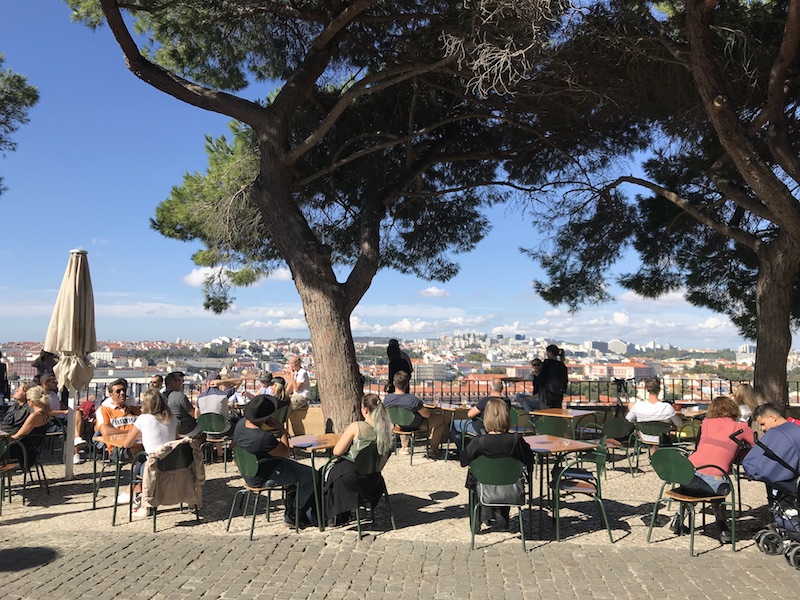
Trips in and around Lisbon
Belém and the Monument to the Discoveries
Spend half a day in Belém visiting Padrão dos Descobrimentos, the Monument to the Discoveries, Jerónimos Monastery and Belém Tower. The tower reopened after renovation in May 2026 and uses timed entry slots. The monastery is closed on Mondays and standard admission costs €18. Belém is also home to the famous pastéis de Belém, which you can try close to the monastery.

MACAM: contemporary art on the way to Belém
If you enjoy modern and contemporary art, add MACAM on your way to Belém. The museum opened in 2025 in a palace at Rua da Junqueira 66, with a new building alongside it. It works well as another stop in this part of the city or as a rainy-day option. It opens from 10 am to 7 pm and is closed on Tuesdays.
MUDE: design and fashion in Baixa
On a rainy day, you do not have to leave the centre for the aquarium. At Rua Augusta 24, MUDE design museum displays furniture, fashion and other everyday objects. A full ticket costs €15, or €13 for the long-term exhibition alone. Children aged 12 and under enter free, and families with up to two adults and children up to age 18 can get a 50% discount. The museum is closed on Mondays.
A beach day in Cascais
The great thing about Lisbon is that you can jump on a train and be at the beach before long. I recommend going all the way to Cascais, having lunch there and taking it easy by the sea.
Sintra and travesseiro pastries
Another trip you should not miss is Sintra. Direct urban trains from Rossio usually take around 40 minutes. If you want to combine the train with Lisbon public transport, the €11.40 Carris/Metro/CP 24-hour ticket is useful. To avoid organising trains and transfers between sights, choose an organised Sintra, Cabo da Roca and Cascais tour. In Sintra, try a sweet travesseiro pastry and a cheese-based queijada. Book your date and exact entry time for Pena Palace ahead. The time on your ticket is for entering the palace interior; allow roughly another 30 minutes to get from the park entrance to the palace. Late arrivals will not be admitted. Do not drive your own car to the palace: take bus 434, a taxi or a tuk-tuk from central Sintra. Buy Pena Palace tickets.
Peniche
Flying to Lisbon does not mean you have to stay in Lisbon. We wanted to get beyond Portugal’s capital, so we hired a car and spent four nights in Peniche, a surfers’ paradise. We had a brilliant time, and I really recommend this characterful place to stay, with its excellent breakfast served in a glass-roofed atrium.

Lisbon with children
If you are travelling with children, visit Lisbon’s Oceanário. The huge central aquarium is impressive for adults too, and it is best to buy tickets ahead. You can find more ideas on Lisbon for Kids. Before our flight home, we found a children’s play area beside the Soho restaurant at Lisbon Airport. Its location and availability may change, so check when you are there.
My friend Yuhů’s website has basic Lisbon information (in Czech), including the weather.
Nightlife in Lisbon
Try this evening cruise with an open bar and a DJ on board. For an unusual rooftop bar on top of a car park, head to PARK.


You certainly will not be bored in Lisbon. Find the current cultural calendar at Agenda Lisboa. There is also plenty going on at the Belém Cultural Centre, which you can reach by train from Cais do Sodré. Check the programme and admission arrangements for individual exhibitions before visiting.
For dinner and a varied cultural programme, try Restô do Chapitô, a restaurant set up by the local circus school at Rua Costa do Castelo 7. One thing to taste is a pastel de bacalhau, a fried salt-cod fritter.
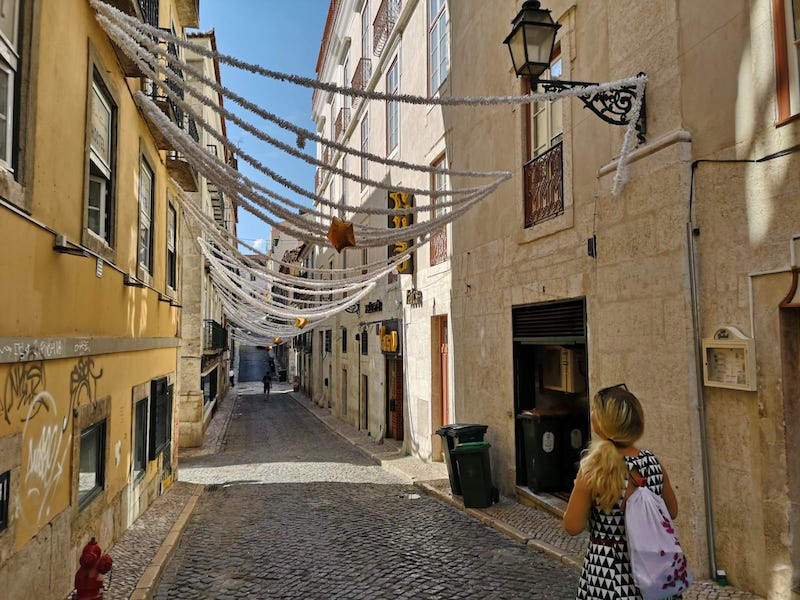
In the evening, everyone gathers in Bairro Alto. After midnight, its maze of narrow lanes, with one bar after another, gets so full that it is hard to walk through. People stand outside drinking and chatting. You go inside for another beer or a trip to the loo.
One particular bar here serves a beer speciality flavoured with coffee and caramel, called Ponta pé na cona. I will spare you the translation, as it is rather rude. Ask around using the drink’s name and you should find the bar.

Around 2 am, the more determined night owls move towards Cais do Sodré and Pink Street. Jamaica, which we remember from Rua Nova do Carvalho, is still going, but is now at Cais do Gás 1. It usually stays open until morning from Wednesday to Saturday. On Fridays and Saturdays, the venues between Cais do Sodré and Santos and the dockside bars are lively too.
Around 4 am, those still going strong might move on to Lux Frágil near Santa Apolónia (Av. Infante D. Henrique, Armazém A). It is a multi-level club with a rooftop terrace. Check the programme and opening hours for the night you plan to go.
Lisbon FAQs
How many days do you need in Lisbon?
For a first visit, I recommend 3 to 4 days. You can cover the historic centre in one busy day, spend another half-day to a day in Belém, and allow a full day for Sintra or Cascais.
What can you see in Lisbon in 3 days?
On day one, explore Baixa, Rossio, Alfama, São Jorge Castle and the viewpoints. Spend day two in Belém, LX Factory, Chiado and Bairro Alto. Head to Sintra on day three, or swap it for Cascais in good weather.
When is the best time to visit Lisbon?
Spring and autumn tend to be most comfortable for exploring on foot. In summer, expect heat, strong sunshine and more visitors. Winter is mild but rainier, and the Atlantic wind can be chilly.
How do you get from Lisbon Airport to the centre?
During the day, the easiest option is the red metro line from Aeroporto, usually with one change for the historic centre. At night, take bus 208 or use a taxi, Bolt or Uber.
Is a Lisbon day ticket worth it?
The €7.25 Carris/Metro ticket can be worthwhile if you will take several metro, bus or tram rides within 24 hours. For a day including Sintra or Cascais, consider the €11.40 Carris/Metro/CP option. If you mainly walk around the centre, zapping credit is usually cheaper.
Where should you stay on a first visit to Lisbon?
Baixa and Chiado are the most convenient. Alfama has more atmosphere but also more hills. Choose Bairro Alto or Cais do Sodré for nightlife, or Estrela, Lapa and Avenidas Novas for quieter nights.
Can you visit Sintra without a car?
Yes. Direct trains run from Rossio to Sintra, where bus 434 continues towards Pena Palace. Entry to the palace interior is timed. Allow around 30 minutes to get from the park entrance to the palace; late arrivals are not accepted.
What is Lisbon famous for?
Lisbon is known for yellow tram 28, blue-and-white azulejo tiles, Alfama, its miradouro viewpoints, the monuments in Belém and pastel de nata custard tarts.
What should you eat and drink in Lisbon?
Try pastel de nata, bacalhau salt cod, grilled sardines, a bifana pork sandwich and ginjinha sour cherry liqueur. Coffee and pastries usually cost less in ordinary neighbourhood pastelarias than beside the main sights.
Does Lisbon have beaches?
The historic centre is on the Tagus River rather than an ocean beach. For a swim, take a train from Cais do Sodré towards Carcavelos, Estoril or Cascais. Cascais also makes a good day trip for lunch and a walk beside the ocean.
Is there a tourist tax in Lisbon?
Yes: €4 per person aged 13 and over, per night, charged for up to seven nights per stay. With some bookings, you pay it at the property.
This article contains affiliate links. If you book through them, I receive a small commission at no extra cost to you.
Read next: São Miguel, Azores


I started travelling after finishing secondary school in 2005. Since then, I have studied in New Zealand and lived in Malta, Madeira, Brittany and Porto. I speak English and French, some Portuguese and very basic Chinese. I travel with hand luggage only and used to stay through Couchsurfing; these days, I use HomeExchange. I travel with my two children. Professionally, I am an agile coach, and I also perform improvisational theatre. Read more about me and my work as a Czech travel influencer.