Packing toiletries in hand luggage for a flight from an EU airport? The standard rule is containers of 100 ml or less, all fitting inside one transparent, resealable bag of no more than 1 litre per person. Creams, gels, toothpaste and cosmetic sprays count too. The bag must close properly, so the packaging itself takes up some of that space.
I usually travel with hand luggage only, and over the years I have found plenty of ways to make my toiletries fit, even when packing for the children. Below are my favourite solid alternatives, the products I share with my husband and the small packing habits that save me trouble. I also explain the difference between what has passed security on my own trips and what the rules actually allow.
EU liquid rules: what to check before you pack
Use the 100 ml rule as your starting point, then check your departure airport, your return airport and any connection where you will pass through security again. Some airports have different arrangements, and modern scanners can change whether you need to unpack your liquids. Flying within the EU does not mean every checkpoint works in exactly the same way. The EU luggage guidance explains the basic restrictions.
Which toiletries can you take in hand luggage?
There are two things to think about: the security rules for liquids and the airline restrictions on aerosols and other potentially hazardous products. Ordinary shampoo, shower gel and moisturiser can go in your liquids bag in small containers. Hairspray and aerosol deodorant need the same care over size, plus protection against accidental spraying. I prefer to keep sprays to a minimum when packing.
| Toiletry | Allowed in hand luggage? | How to pack it |
|---|---|---|
| Shampoo, shower gel and perfume | Yes, as liquids | Containers up to 100 ml, inside the liquids bag |
| Cream, sunscreen and toothpaste | Yes, as liquids | Small samples count too |
| Mascara, liquid foundation, lip gloss and liquid lipstick | Yes, as liquids | Inside the liquids bag, even in miniature sizes |
| Roll-on, gel and cream deodorant | Yes, as liquids | Up to 100 ml, inside the liquids bag |
| Solid deodorant, soap and shampoo bars | Yes, as solids | Outside the liquids bag |
| Hairspray and aerosol dry shampoo | Yes, subject to aerosol rules | Up to 100 ml, inside the liquids bag; protect the valve |
| Loose powder, dry eyeshadow and powdered dry shampoo | Yes, as dry products | In your toiletry bag |
| Solid lipstick | Yes, as a solid | Outside the liquids bag |
| Liquid toiletries in containers over 100 ml | Not under the standard rule | Use a smaller container or checked baggage |
| Small liquid toiletries that do not fit in the closed 1-litre bag | Not within the standard allowance | Take fewer liquids or switch to solid products |
This table uses the standard 100 ml limit. What matters is the actual consistency: a gel or cream still counts as a liquid, whatever the product name suggests. Dry and genuinely solid toiletries do not use up your liquids allowance. They still count towards your bag’s total weight and must fit within the baggage size allowed by your airline.
How I pack toiletries for a flight
What helps when everything will not fit
- No room in the liquids bag? Swap some shampoo, soap or deodorant for solid versions.
- Want to take your usual products? Use refillable bottles of 100 ml or less and take only what you need.
- Wet soap making a mess? Use a suitable case that contains the moisture while allowing the bar to dry.
My toiletries packing routine
I put my liquid products in a clear resealable bag, close it and then put the whole thing inside another plastic bag. That extra layer is my insurance against a leak: I have had cream all over my backpack more than once. The rest of my toiletries go in a separate wash bag. Over years of flying, I have settled into the routine below.
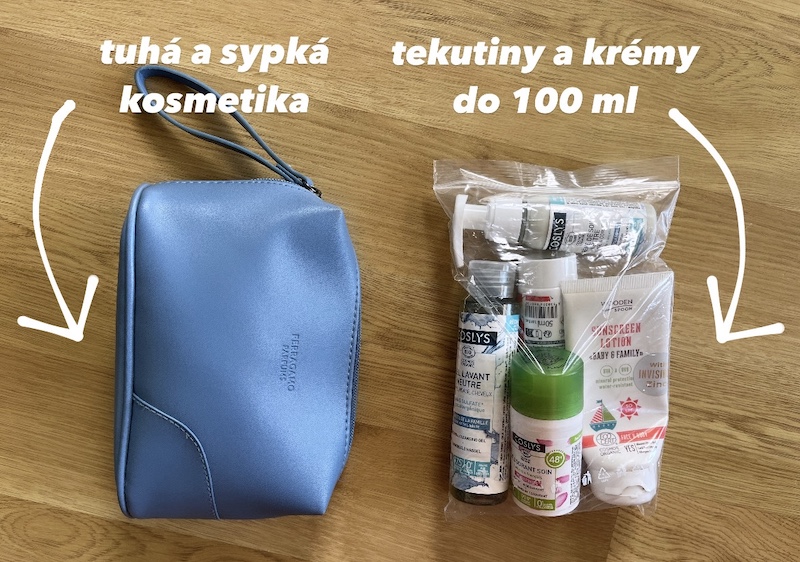
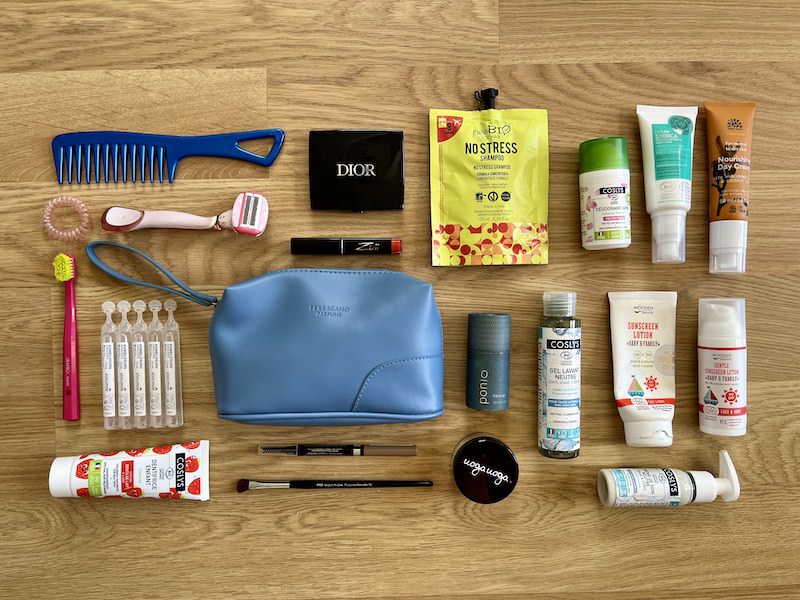
- When I have a lot to pack, I take more solid products and fewer liquids: shampoo bars, solid soap, natural solid deodorant and Ponio solid conditioner. Solid soaps also come in cleansing and intimate-wash versions. I really recommend dry shampoo too; choose powder if you want it outside the liquids allowance.
- For wet bars, I recommend the Matador FlatPak Soap Bar Case: it contains the moisture and lets the products dry after use.
- I take a shorter travel toothbrush because it fits better in my wash bag.
- For years I have used loose mineral foundation instead of liquid foundation.
- I pack miniature shampoos and shower gels, or decant products into travel bottles. My creams are usually already under 100 ml.
- For contact lenses, I have come to prefer individual ampoules, one for each day, rather than carrying a whole bottle for a three-day trip. Check with your airport if you need a larger bottle of solution under a medical exception.
- The children each have their own liquids allowance too, so if my bag is full, there may be room in theirs.
- I prefer flying with hand luggage only because keeping my bag with me avoids the usual risk of checked luggage being lost or delayed.
The toiletries I take on trips
These are my own product choices. Check the particular size before buying, because the same product may come in several packs. The Wooden Spoon SPF 50 sunscreen I use is a 150 ml tube, so that container does not meet the standard 100 ml cabin limit. Pack it in checked baggage or choose a smaller version for your liquids bag.
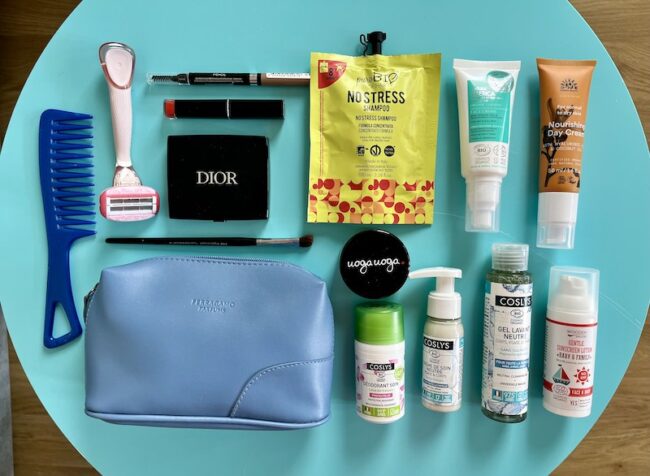
- A unisex deodorant, or Urtekram: my husband and I share one, and I really like this way of saving space.
- A neutral all-purpose face and body cream for the whole family, such as Coslys.
- A three-in-one wash for body, hair and face that the whole family can use.
- Lobey cleansing milk, from a Czech brand based in Brno.
- Uoga Uoga loose mineral foundation, which I have used for years instead of powder too.
- Wooden Spoon SPF 50 sunscreen. They also make SPF 30, but we use SPF 50; watch the 150 ml pack size.
- Natura Siberica day and night cream for dry skin.
- A day cream from the Danish brand Urtekram.
- A travel shampoo, such as the 100 ml Coslys aloe vera shampoo, with enough for several washes.
- Toothpaste in a small tube.
- Incognito insect repellent in a small pump spray or a roll-on repellent.
What I pack for the children
- Nappy cream in a 75 ml tube.
- A body cream suitable for the baby and adults.
- Children’s toothpaste in a 50 ml tube.
- Rūdolfs savoury food pouches. The fish ones are favourites with my children.
- Fruit pouches with oats, which I find more filling.
What size toiletry bottles can you take on a plane?
Refillable bottles let you take your usual products without buying a new miniature every time. They can save money and packaging, although sets often contain identical bottles when you actually need more shower gel and less shampoo. Personally, I do not have much patience for decanting: transferring products from one bottle to another is rarely a spill-free job for me. Choose clearly labelled containers of 100 ml or less.
A half-empty 200 ml bottle does not count as a 100 ml container. Security checks the capacity of the packaging, not how much product is left inside. Glass is not automatically a problem; the same size rules apply. Close every bottle securely and make sure all your ordinary liquid toiletries fit into the single transparent bag with the seal fully shut.
What should you take out at airport security?
At security I usually take out my clear liquids bag, medicines and baby food. I have also travelled with tiny bottles of medicine, such as Fenistil drops, left inside my backpack without being asked to remove them. That is my experience, not an exemption: staff can still ask to inspect even a small bottle separately. Keep anything they may need to check within easy reach.
Follow the instructions at your particular checkpoint. With conventional scanners, you will generally need to remove your liquids bag and larger electronics; some modern scanners let them stay inside. Being allowed to leave a bottle in your bag does not automatically mean larger bottles are allowed. I always recommend checking the airport instructions for both directions of the journey.
One easy mistake is leaving belongings behind after an extra check. I have come across someone who thought security had confiscated several things, when they had simply not collected them from the separate screening lane. Bags may go there for a closer look or a random check. Before walking away, make sure you have collected everything, including anything staff put aside for inspection.
Deodorant, make-up and creams
How to pack deodorant
A roll-on, gel or cream deodorant belongs in your liquids bag, in a container of 100 ml or less under the standard rule. A genuinely solid deodorant can go in your normal toiletry bag. My husband and I have shared one unisex deodorant on trips for years. It saves space, and the fragrance works for both of us rather than smelling distinctly masculine.
Mascara, eyeshadow, foundation and powder
I have used loose mineral foundation for years, including instead of face powder, and I pack dry eyeshadow and powder outside my liquids bag. I also leave my mascara and small toothpaste out, and this has not caused problems at my previous security checks. However, ordinary mascara, toothpaste, liquid foundation, lip gloss and liquid lipstick count as liquids. If you want to pack according to the standard rules, put them in the liquids bag, however small they are.
How much cream can you take?
Cream counts as a liquid, so the standard rule is a container no larger than 100 ml inside your liquids bag. On my own trips, tiny samples and miniature creams of around 20 ml have passed outside that bag without being questioned. That experience does not create an exception for samples. For a larger moisturiser or sunscreen, choose a smaller pack or put the larger container in checked baggage unless your airport explicitly allows it.
Sprays, hairspray and dry shampoo
Cosmetic and medicinal aerosols have their own transport restrictions, so do not assume that every pressurised spray is allowed. For insect repellent, I like the non-pressurised Incognito spray in a small travel bottle. I have also grown fond of a roll-on repellent, which you apply with a ball like a roll-on deodorant. Both liquid formats still belong in the liquids bag under the standard rule.
Can you take hairspray on a plane?
Yes, ordinary toiletry hairspray can travel in hand luggage within the relevant limits. For the standard liquids rule, choose a can of 100 ml or less, put it in your clear bag and protect the valve with its cap or another suitable cover. A partly used 250 ml can is still too large. Aerosol dry shampoo and shaving foam need the same attention to packaging and size.
The 100 ml security limit does not apply to checked baggage, but that does not make aerosols unlimited. IATA’s passenger baggage table sets a maximum of 0.5 litres or 0.5 kg per individual medicinal or toiletry article covered by this rule, with a combined total of 2 litres or 2 kg per person for the relevant articles and aerosols. Protect the valves and check your airline’s own conditions before packing.
Dry shampoo: powder or aerosol?
With dry shampoo, the word “dry” can be misleading. A loose powder does not need to go in the liquids bag, while an aerosol spray does, and its can must meet the standard 100 ml limit. A solid shampoo bar used for washing your hair is another option outside the liquids allowance. These are different products, so check the format before deciding where to pack it.
Razors and nail scissors in hand luggage
Can you take a razor?
Distinguish a disposable or cartridge razor with an enclosed blade from a loose razor blade or an open razor. The EU prohibited-items list includes razor blades; the 6 cm rule for certain other sharp items is not a general permission for every blade. Check your exact type of shaving tool with your departure and return airports. A protective bag cannot make a prohibited blade acceptable.
For my own shaving tool, putting the sharp end inside a small bag has been enough on previous trips. I keep that as a packing experience rather than a promise that any razor will pass. Disposable razors with enclosed blades are a different category from loose blades. If you use a razor with removable blades, pay particular attention to how the airport classifies it.
Can you take nail scissors?
The EU prohibited-items list includes scissors with blades longer than 6 cm, measured from the pivot. That does not mean every smaller sharp item is guaranteed to pass. I know of travellers having scissors taken away; I carry children’s nail scissors with rounded tips, and mine have been accepted on my trips so far. Check the rules for both airports before packing yours.
Toiletries and baby food when flying with children
For the children, I pack a small nappy cream, miniature baby wash and oils, plus items such as antiseptic and Fenistil drops. Ordinary baby wash, oils and cosmetic creams follow the usual liquids rules. The medical exception applies to essential medicines needed for the journey, not automatically to everything in a baby’s wash bag or every bottle of disinfectant. Staff may ask to screen exempt liquids separately.
Baby food and milk needed during the journey can be carried in quantities above 100 ml, subject to screening. This is a separate exception from ordinary toiletries. I like savoury food pouches from the Latvian brand Rūdolfs, especially the fish varieties my children enjoy, and fruit pouches with oats because they are more filling. The EU security FAQs explain the rules for baby food and essential liquid medicines.
Which medicines can you take on a plane?
Essential liquid medicines needed during your journey can be carried in containers above 100 ml, but security may ask you to show what they are and why you need them. If I were taking a larger amount or less familiar medication, I would bring a doctor’s letter. Keep medicines easy to identify and check any destination restrictions separately from airport security, especially when travelling outside the EU.
Our own travel kit usually includes saline nasal spray, eye drops, Fenistil drops, Fenistil gel and antiseptic. I also take melatonin for jet lag. These are the things we pack, rather than a recommendation that everyone should use them; ask a pharmacist or doctor about suitability where needed. Ordinary hand sanitiser should go in your liquids bag under the standard rule rather than being assumed to qualify for a medical exemption.
Found these tips useful? You can buy me a coffee to support my travel guides.
Frequently asked questions
Where should I pack deodorant?
Put roll-on, gel, cream and aerosol deodorant in your transparent liquids bag, in containers up to 100 ml under the standard rule. A genuinely solid deodorant can stay in your normal wash bag.
What should I take out at security?
Follow the signs and staff instructions at your checkpoint. Conventional screening usually requires your liquids bag and larger electronics to come out. Some modern scanners allow them to stay inside. Medicines and baby food may need separate inspection.
How many toiletries can I take?
Under the standard rule, ordinary liquid toiletries must fit in one closed, transparent, resealable bag of no more than 1 litre per person, with each container no larger than 100 ml. Solid toiletries do not use up this allowance, but your airline’s baggage size and weight limits still apply.
Read next: easyJet baggage allowance · Ryanair baggage guide · Rome airports · Things to do in Málaga
I started travelling after finishing secondary school in 2005. Since then, I have studied in New Zealand and lived in Malta, Madeira, Brittany and Porto. I speak English and French, some Portuguese and very basic Chinese. I travel with hand luggage only and used to stay through Couchsurfing; these days, I use HomeExchange. I travel with my two children. Professionally, I am an agile coach, and I also perform improvisational theatre. Read more about me and my work as a Czech travel influencer.