
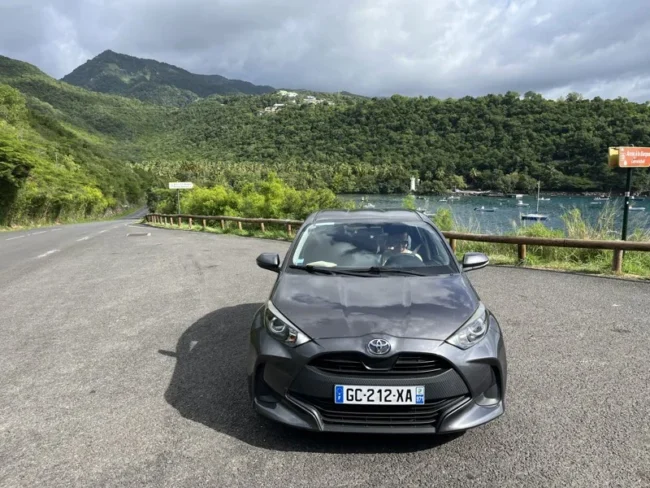
We found driving in Guadeloupe fairly easy, and I would recommend hiring a car if you want to explore all parts of the island. Our rental company was a short shuttle ride from the airport, we did not have to wait long, and we hired the child car seats from them too. The main thing I would warn you about is other drivers. Some local drivers drove very fast and took risks that made us uncomfortable, so this is a place to drive calmly and leave plenty of space.
Hiring a car in Guadeloupe: our airport experience
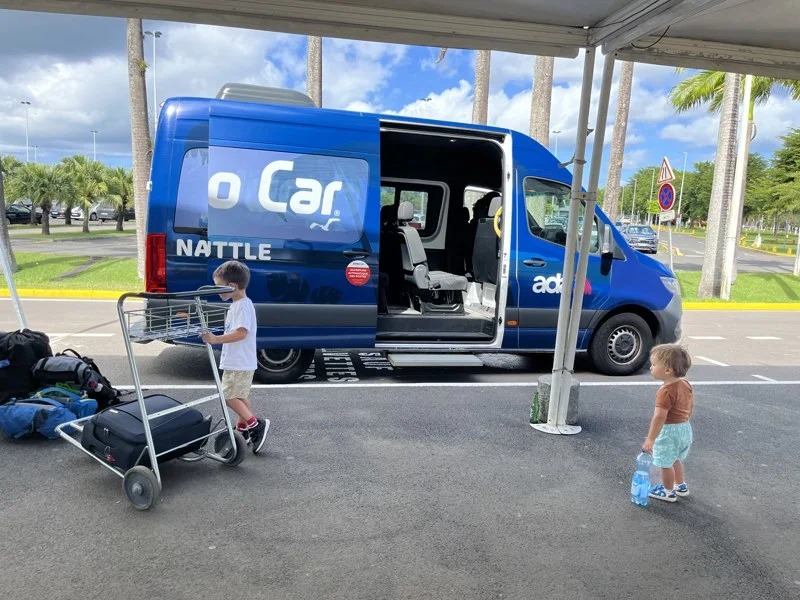
Our collection point was outside the airport, so we took the rental company’s shuttle to its nearby office (free of charge). This worked well for us and the wait was not long. Allow time for the return shuttle before your flight home too – as you can see from the photo below, there are only 6-8 passengers who fit into a shuttle per ride.
For booking, I recommend comparing car hire in Guadeloupe on Discover Cars. It lets you compare offers from different rental suppliers and find the best match – highest rating for the lowest price. I always choose the rental company that has a rating above 8. Look also at recent reviews in Google Maps – this is crucial! A low headline price is less helpful if the collection arrangements or deposit do not work for you.
Check the difference between the rental company’s excess and any extra cover you buy. Read the terms of your particular offer, including exclusions and how claims are handled. Before leaving the car rental company office, take photos of the existing damage, wheels, windscreen and fuel level, and make sure any marks are recorded on the collection report.
🚗 Compare Guadeloupe car hire on Discover Cars and check the deposit and shuttle arrangements.
Child car seats: we hired ours from the rental company
We used child seats supplied by the rental company, which meant we did not have to bring our own on the flight. I would arrange them in advance and give the company each child’s height, weight and age, rather than just asking for “a child seat”. At collection, check the seat’s condition, suitability and installation before driving away. Also confirm how the children will travel on the airport shuttle, as the transfer vehicle and its arrangements may differ from your rental car.
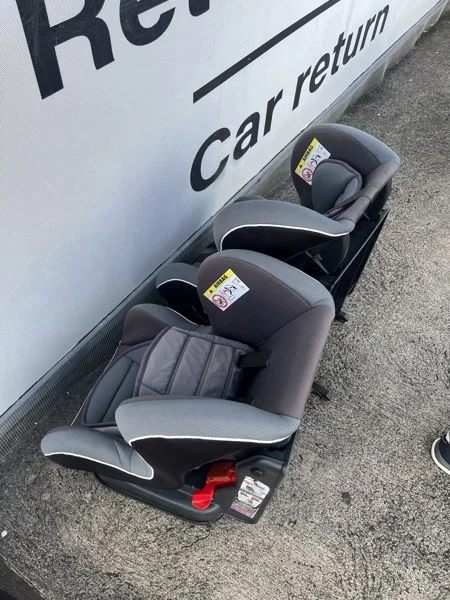
Under French child restraint rules, children under 10 generally travel in the rear in an approved restraint suitable for their size, with specific exceptions. If you prefer bringing your own seat, check the airline’s baggage rules and protect it for transport. A BabyStyle transport bag from the Czech retailer Alza is one option, provided your seat fits its dimensions. A bag does not guarantee protection from rough handling.
Is driving in Guadeloupe safe? What the accident figures show
It felt to us as though there were quite a lot of accidents, and the speed of some drivers certainly stood out. That is our personal impression, rather than a measure of how likely a visitor is to have a crash. The official figures do show that road safety deserves attention, even though driving itself did not feel especially difficult to us. I would hire a car again, but I would not copy the pace of an impatient driver behind me.
The official Guadeloupe road safety report for 2025 records 530 injury accidents and 49 deaths, compared with 616 injury accidents and 54 deaths in 2024. These are crashes involving injury or death, not every scrape or parking collision. The annual figures fell, so it would be misleading to say that accidents simply keep increasing. They also do not provide a separate risk estimate for tourists driving rental cars.
Alcohol and driving in Guadeloupe
Guadeloupe follows French drink-driving rules. For most drivers, it is illegal to drive at a blood alcohol concentration of 0.5 g/l or above, equivalent to 0.05%. For drivers covered by the probationary licence rules, the threshold is 0.2 g/l, or 0.02%. The corresponding breath alcohol thresholds are 0.25 mg/l and 0.10 mg/l. These are legal thresholds, not a safe allowance of drinks. You can check the details on the French government’s drink-driving page.
My advice is simple: if you are driving, skip the alcohol. A ti’ punch or a rum tasting is not something I would try to fit around a guessed number of “safe” drinks. Choose a driver who will not drink, or arrange transport before going out. Do not assume that a meal, coffee or a short wait makes you fit to drive, and remember that alcohol can still affect you the following morning.
What to watch out for on Guadeloupe’s roads
Fast drivers and risky overtaking
Some of the driving we saw was fast and, to me, dangerous. Keep a generous gap, check your mirrors and expect other drivers to make mistakes. If someone follows too closely, stay predictable and let them pass when it is safe. Do not speed up to match them or pull onto an unsafe verge. Be especially careful before turning, and look out for motorcycles, cyclists and people walking beside the road.
Mountain roads, bends and heavy rain
Plan a gentler pace on Basse-Terre, where mountain roads can be winding and steep. The tourist board describes the Route de la Traversée as a scenic drive through the national park, but bends and wet conditions call for care. Slow down before corners, use a suitable low gear on descents and do not treat a short distance on the map as a quick journey. Stop only where you can pull completely off the road safely.
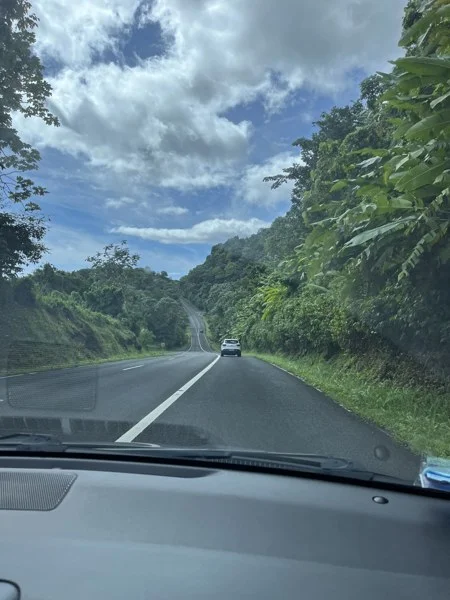
Heavy rain can change a drive very quickly. Reduce speed, increase your following distance and check local weather alerts before a longer trip. Never drive into a flooded road or around a closure barrier, even if another driver goes through first. The French authorities explicitly advise against entering flooded roads. If visibility becomes poor, find a safe place off the carriageway to stop rather than pushing on to keep to your itinerary.
Driving after dark and airport traffic
I would plan unfamiliar mountain and rural drives for daylight wherever possible. The US travel advice for Guadeloupe specifically warns about night driving on winding rural and mountain roads. Around Pointe-à-Pitre and Jarry, allow for commuter traffic too. On departure day, add time for refuelling, the vehicle inspection and your shuttle transfer. The fact that our collection was quick does not mean every airport journey will be.
French road rules, speed limits and roundabouts
Drive on the right, and remember that speed signs use kilometres per hour. The usual French limits for cars include 50 km/h in built-up areas and 80 km/h on two-way roads without a central divider, with exceptions and locally signed limits. Divided roads can have higher limits, but do not assume that a wide road allows 110 km/h. Follow the signs, including lower limits in towns, and check the rules for rain and novice drivers.
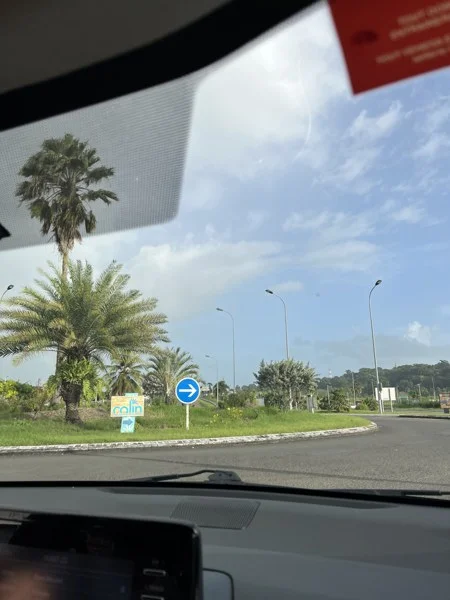
At junctions, follow the signs and road markings rather than assuming the bigger road has priority. Priority to the right can apply where no signs say otherwise. At roundabouts with give-way signs on entry, let circulating traffic pass first. Wear seat belts in every seat, set your navigation before you move and stop safely if you need to use your phone. A missed turn is much easier to deal with than a sudden manoeuvre.
Parking, luggage and the condition of your hire car
Choose proper parking spaces and avoid leaving bags, phones or other valuables visible in the car. Ideally, drop luggage at your accommodation before stopping for a beach visit or walk. Watch for potholes and rough edges, especially when pulling off a main road, and avoid parking directly under coconuts. Before accepting the car, check the tyres, lights and wipers, and make sure you know the correct fuel type and where the safety equipment is kept.
Which driving licence do you need?
A valid EU or EEA driving licence is generally recognised in France. For a short visit with a non-EU/EEA licence, the French government says it must be valid and written in French or accompanied by an international driving permit or an official translation, with an exception for British licences. Check the current requirements for your licence before booking. An international permit accompanies your original licence and does not replace it. Rental companies may also set their own minimum age and licence-holding requirements.
Planning stops and a break from driving
Group your stops by area instead of crossing back and forth across the island every day. If you add a boat trip or a snorkelling excursion, check the departure point, parking and check-in time before choosing your driving route. A boat excursion does not automatically include a transfer from your accommodation. Below you can compare Guadeloupe boat and snorkelling options, but check the individual transport arrangements and keep the driver alcohol-free for the journey back.
📖 More ideas for your route: my Guadeloupe travel notes (in Czech).
My advice before you book
For us, hiring a car in Guadeloupe was straightforward. The short airport shuttle worked well, the wait was reasonable and getting the child seats from the rental company made the journey easier. I would compare rental offers on Discover Cars, choose a supplier with clear collection instructions and leave enough room in the budget for the right car and seats. Once on the road, take your time, leave alcohol for when you are not driving, and do not let someone else’s hurry become yours.
Driving in Guadeloupe: quick questions
Which side of the road do you drive on in Guadeloupe?
You drive on the right. Road signs use kilometres per hour.
Can you hire child car seats in Guadeloupe?
We hired ours from the rental company. Reserve the right seat in advance and check its condition, fit and installation at collection.
What is the drink-driving limit in Guadeloupe?
Driving is prohibited at 0.5 g/l blood alcohol or above for most drivers, and at 0.2 g/l for drivers subject to the probationary rules. My advice is to avoid alcohol completely if you will be driving.
Read next: Toiletries in hand luggage · Guadeloupe travel notes (in Czech)

I started travelling after finishing secondary school in 2005. Since then, I have studied in New Zealand and lived in Malta, Madeira, Brittany and Porto. I speak English and French, some Portuguese and very basic Chinese. I travel with hand luggage only and used to stay through Couchsurfing; these days, I use HomeExchange. I travel with my two children. Professionally, I am an agile coach, and I also perform improvisational theatre. Read more about me and my work as a Czech travel influencer.