
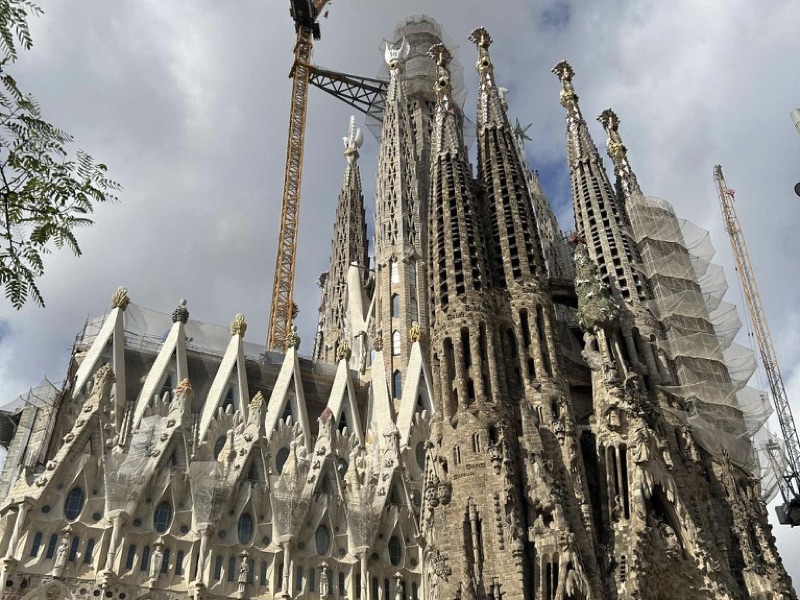
You can see Barcelona’s main sights in three days, although I would personally stay a little longer and combine the city with the Costa Brava. Below you’ll find my suggested route, tips for visiting the Sagrada Família, places to eat tapas and paella, and where to go for good coffee. I would book the busiest sights first and leave time between them to enjoy the city.
Barcelona is the capital of Catalonia, so you will see and hear Catalan as well as Spanish. Menus, street notices and signs may be in Catalan, but Spanish is widely understood. English is useful in many tourist-facing places, though I would still save a few basic Spanish or Catalan phrases on your phone. A downloaded translation app is handy when a menu has no English version.
What to book before your Barcelona trip
- Save an offline translation app and a few useful Spanish or Catalan phrases.
- Book a timed Sagrada Família ticket in advance.
- Reserve Park Güell at least a few days ahead, and earlier for busy dates.
- If you prefer a guided visit, compare this combined Sagrada Família and Park Güell tour. Check the duration and inclusions of the option you choose.
- Look at accommodation alongside flights. We search through Booking. Choose your own dates and compare the total price, location and cancellation terms. My hotel suggestions are below.
- If you want airport lounge access, check your own bank card or membership benefits before travelling. Eligibility and guest charges depend on your card and country.
I also use GetYourGuide myself, including for a whale-watching trip in the Azores (in Czech). If you book through the app, the discount below is worth checking. Compare what each ticket includes, especially whether a guide or a tower visit is part of the price. A reseller’s package can cost more than basic admission bought directly from the attraction.
🎟️ Save 5% with CESTUJZABABKU5, valid only in the app downloaded through this GetYourGuide link.
My Barcelona itinerary for 3 days
What should you see in Barcelona in three days? This is the route I would use, with the main Gaudí sights on day two. You do not have to go inside every building. If you prefer a slower pace, choose your priorities before buying timed tickets and allow for travel between them. Barcelona is much more enjoyable when there is time for coffee and lunch too.
Day 1: the old town, markets and tapas
Start on Passeig de Gràcia, then explore Barri Gòtic, the Gothic Quarter, and El Raval. Visit Mercat de la Boqueria, Barcelona’s most famous food market, and try some jamón ibérico, the cured Iberian ham you will see on many menus. Make time for paella or tapas as well. I have included specific restaurant tips below so you can choose somewhere that fits your route.
Day 2: Gaudí’s Barcelona
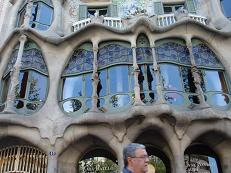
Spend the morning at the Sagrada Família, then continue to Park Güell and Casa Batlló. This is a full day if you visit all three inside, so leave generous gaps between bookings. For a view, consider Bunkers del Carmel at Turó de la Rovira, but do not automatically plan it for sunset. The site closes at 19:30 from May to September and 17:30 from October to April. Check the current opening hours before heading up.
Day 3: Montjuïc and the beach
Walk along La Rambla, explore Montjuïc on foot or take the Montjuïc cable car, then spend the afternoon around Barceloneta. Parc de la Ciutadella is another pleasant stop if you have time, though it means crossing back towards the other side of the old town. Finish with dinner overlooking the sea. My food suggestions below include places by the beach as well as in the Gothic Quarter.
🏖️ Add a day trip to the Costa Brava (in Czech) or Girona. Friends also recommended Sitges to me.

Where to stay in Barcelona
Barcelona has plenty of hotels and hostels. If you really want to keep costs down, consider a bed in a shared dormitory, with female-only or mixed options depending on the property. TOC Hostel Barcelona is worth checking for its pool and breakfast buffet. Look carefully at the room type and whether breakfast is included in the rate you select.
For a private room, compare the options at The Central House Barcelona Gràcia. A private hostel room does not automatically mean a private bathroom, so read the details before booking. For a romantic break, take a look at H La Paloma Boutique. It is a different style of stay from a sociable hostel, which is why I would choose according to the kind of trip you want.


chic&basic Lemon is another option I recommend comparing for its central location and stylish interior. I would prioritise a rate with free cancellation where possible, especially if your plans may change. Always compare the final total for your dates, including any taxes shown separately, rather than assuming one hotel will be the cheapest throughout the year. You can also search for more accommodation on Booking.

Compare accommodation on the map: enter your dates to see hotels and apartments around the areas you want to explore.
Where to eat in Barcelona: tapas, paella and coffee
For good coffee, try Hidden Coffee Roasters, which has several locations including El Born. Its current locations page also lists The Hidden Oasis on Passeig del Mare Nostrum, so check the branch you want before making a special trip. For paella, I recommend Sal Mar on Barceloneta. There is also an Honest Greens by the beach for salads and other lighter meals.
For tapas, try one of the Sensi restaurants. A friend really liked Gourmet Sensi, although she had originally wanted to go to Petit Tapas and found it fully booked. That is why I recommend reserving ahead rather than relying on walking in. You can enjoy the atmosphere of Barri Gòtic at the same time, with a wander through the Gothic Quarter before or after your meal.
By the harbour, El Tribut has an interior that reminds me of Gaudí’s work. I also received recommendations for the family-run Restaurante Teruel in the centre and Pastisseria Hofmann for something sweet. Check the opening hours of the branch you choose and book if there is somewhere you particularly want to eat.
If you are on a tight budget, buy some food in a supermarket and prepare a few meals yourself. There is a Carrefour on La Rambla, which can be useful while exploring the centre. I would not give one fixed price for coffee, tapas or jamón ibérico because the cost varies so much with the place and quality. Check the menu before sitting down, especially right beside a major attraction.
Barcelona sights: tickets and practical tips
How to visit the Sagrada Família
Buy your Sagrada Família ticket in advance for a specific time. Official basic admission currently costs €26, or €36 with a tower visit. These are the basilica’s own prices, so do not assume every guided tour or reseller package costs the same. You can check the official ticket options and read my more detailed Sagrada Família guide (in Czech).
Children under 11 have free admission under the official rates. Children aged 3 and over still need a ticket, while under-3s do not. Children under 6 cannot visit the towers, and those aged 6 to 15 must be accompanied by an adult. You take a lift up and walk down the stairs. Bring your own earphones for the mobile audioguide and arrive with a charged phone.
For a tower visit, backpacks and bags must be left in the designated lockers. Pack lightly and allow time for the security check before your entry slot. This is a church, so dress appropriately, and bring photo ID because the official tickets are named. If you choose a tour through GetYourGuide, read its meeting instructions carefully, as the meeting point may be different from the entrance used by independent visitors.
Park Güell: book ahead and allow for the hill
One way to reach Park Güell is to take metro line L3 to Lesseps and walk from there. Allow around 20 minutes on foot. The park recommends the approach via Avinguda del Santuari de Sant Josep de la Muntanya, where escalators help with the climb, but you should still expect some uphill walking. Leave a buffer before your booked time, especially if you are travelling with children.
Tourist visits require a ticket, so do not rely on old advice that most of the park is free. The official price is €18 for adults and €13.50 for children aged 7 to 12. Children aged 0 to 6 enter free but still need a ticket. You can enter up to 30 minutes after the time shown, then stay until closing. Once you leave, you cannot re-enter on the same ticket.
Which Barcelona cable car should you choose?
Barcelona has two different tourist cable cars, and it is easy to confuse them. The Telefèric de Montjuïc runs from Parc de Montjuïc up to the castle. The older harbour cable car, Transbordador Aeri del Port, crosses above the port between Torre de Sant Sebastià in Barceloneta and Miramar on Montjuïc. It passes Torre Jaume I, but that tower is closed as an access point.
If you want the ride above the harbour, check the harbour cable car’s own website and make sure you buy the correct ticket. Queues and the quieter direction can change during the day, so I would not rely on one fixed rule. You can combine the ride with a walk around Montjuïc and Sant Sebastià beach, depending on which end you start from.
Poble Espanyol: the Spanish village
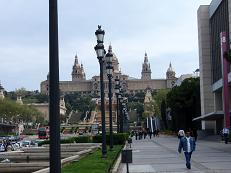
Poble Espanyol was built for the 1929 International Exhibition. You will find it on Montjuïc, and it is a lovely place to wander on a sunny day. Alongside traditional houses and streets inspired by different parts of Spain, there are craftspeople at work, including glassmaking. The Fran Daurel Museum also has works by artists such as Picasso, Dalí and Miró, so there is more here than an outdoor architectural display.
According to the official price list, adult admission costs €14.40 when booked online in advance and €16 on the day. Children aged 4 to 12 pay €9 in advance or €10 on the day, while under-4s enter free. A family ticket for two adults and two children costs €42. You can book on the official ticket website.
Getting to Barcelona: choose the right airport
For a short city break, I would start by looking at flights to Barcelona-El Prat (BCN). Compare routes from your own departure airport and include baggage, arrival time and the transfer to your accommodation in the total cost. A very cheap flight is less useful if it leaves you with an awkward late-night journey. Check accommodation prices at the same time, especially for weekends and major events.
Do not confuse BCN with Girona-Costa Brava (GRO) or Reus (REU). They are separate airports outside Barcelona, so you need to allow for a longer transfer and check the onward timetable before booking. Girona can make sense if you are combining the city with the Costa Brava (in Czech). Choose according to your whole itinerary rather than the airfare alone.
Barcelona public transport and airport transfers
T-casual or T-usual?
You can cover a lot of Barcelona on foot. For several public transport journeys, the one-zone T-casual gives you 10 journeys for €13. It is for one person at a time, so a couple cannot use it together for the same journey. A single ticket costs €2.90. Check the current TMB fares and allow for the separate cost of a new travel card if you need one.
The one-zone T-usual currently costs €22.80 and covers unlimited journeys for 30 consecutive days from first use, including the airport metro. It is personal and non-transferable, and you need to carry the identity document linked to it. Even on a short trip it can be worth comparing if you will use transport frequently. The official T-usual page explains the card and ID requirements.
Airport bus 46 and night buses
A budget option from El Prat is bus 46 to Plaça d’Espanya, which accepts ordinary integrated tickets. At night, N17 serves Terminal 1 and N18 serves both terminals. A free airport shuttle connects T1 and T2. Check your exact terminal and the airport’s bus information before travelling, then compare the final walk or metro connection to your hotel.
Airport train and metro: the ticket difference
The T-casual is valid on the R2 Nord airport train from Terminal 2. The train normally runs about every 30 minutes and stops at Barcelona Sants and Passeig de Gràcia, among other stations. If you arrive at Terminal 1, take the free shuttle to T2 for the train. Leave time for that extra step when comparing it with a direct bus from your terminal.
The T-casual is not valid for entering or leaving the metro at Aeroport T1 or Aeroport T2 on L9 Sud. For that journey you need the €5.90 Airport Ticket or another pass that includes the airport metro, such as T-usual. L9 Sud does not go straight into the historic centre, so most visitors need to change lines. The cheapest-looking option may not be the easiest for your particular hotel.
Aerobús to Plaça de Catalunya
Aerobús is a convenient option if you are staying near the centre. A1 serves Terminal 1, A2 serves Terminal 2, and both finish at Plaça de Catalunya. A single ticket costs €7.45 and a return €12.85. The service operates 24 hours a day, with frequent daytime departures and a less frequent overnight service. Ordinary T-casual and T-usual tickets do not cover Aerobús.
Tourist traps in Barcelona: pickpockets and costly mistakes
A friend of mine had things stolen from her handbag in a Barcelona café. That is why I would be just as careful when sitting down for coffee as when squeezing onto a busy metro. Keep your handbag zipped and on your lap or close against your body, rather than hanging it over the back of a chair. I would also keep a phone off the table and avoid leaving a bag unattended while ordering.
For the tourist traps that cost you money rather than your belongings, I would start with the menu and the booking details. Before ordering near a major sight, check the prices of drinks as well as food and ask about anything unclear. For attractions, compare basic admission with what a guided tour actually includes. Paying more can make sense for a guide or an extra experience, but make sure you want those extras before buying.
Be particularly careful with pickpockets in Barcelona. Locals warn visitors about them for good reason. One person may distract you while another reaches for your phone or wallet, so avoid carrying valuables in a back pocket. Keep your bag in front of you on the metro, around La Rambla and near busy attractions. A little care is much easier than dealing with a missing passport or phone during a short trip.
If you have a large suitcase, look for luggage storage around Barcelona Sants rather than carrying it around all day. Check the exact location, opening hours and collection deadline before reserving. Prices and operators vary, so use the details for your own travel date. This is particularly useful if your checkout is early but your flight or train leaves much later.
Shopping in Barcelona
You will come across shops almost everywhere in Barcelona, including the old town, La Rambla, Avinguda del Paral·lel and Avinguda Diagonal. Sunday opening varies, so do not assume every shop will be open. Designated tourist areas have additional seasonal Sunday opening, while other shops follow different schedules. Maremagnum shopping centre is at the end of Moll d’Espanya by the harbour and is worth checking if shopping is part of your waterfront walk.
Other large shopping centres include L’Illa Diagonal and Westfield Glòries. Near Plaça de les Glòries Catalanes you will also see the distinctive Torre Glòries, formerly known as Torre Agbar. If you are making a special trip to a particular shop, check its own opening hours first. That matters especially on Sundays and public holidays, when a shopping centre and its individual shops may have different arrangements.
Barcelona in winter
Do not be afraid to visit Barcelona in winter. Daytime weather can be pleasant, but mornings, evenings and windy days can feel cold, so bring layers and a light waterproof jacket. Outside Christmas and other holidays, there may be fewer visitors and better accommodation prices than in the busiest season. I would see it as a city break with time outdoors, rather than expect a beach holiday. Pickpocket precautions still matter all year round.
How to buy FC Barcelona football tickets
A football match could make a lovely birthday present for your partner, or just an extra part of the trip. Football is not really my thing, but I did go to an FC Porto match in Porto (in Czech) and it was an experience. If someone you are travelling with is a fan, it is worth checking the fixture list before you settle on your travel dates.
The safest place to buy is the official FC Barcelona ticket website. Choose a home match and the available seating category. Prices vary by opponent and section. If ordinary tickets are not on sale yet, use “Let Me Know” where offered to receive an alert. Buying through an unofficial reseller can leave you paying too much or holding a ticket that is not valid.
Be careful when booking flights around a match. The exact LaLiga date and kick-off time may not be confirmed until 10 to 15 days beforehand. Treat a date shown far in advance as provisional and avoid booking your arrival or departure too close to it. A Friday-to-Monday stay gives more flexibility for many weekend fixtures, but it is not a guarantee. Changeable accommodation and transport are useful here.
Home fixtures for the 2026/27 season are listed at Spotify Camp Nou, where redevelopment continues. Always check the venue for your chosen match. Tickets use the FC Barcelona Tickets app, so download it before travelling, sign in with the same email used for the purchase and complete the visitor details. The QR code is activated around two hours before kick-off. Take a charged phone and follow the instructions attached to your booking.
More places I recommend in Spain
If Spain’s milder weather appeals to you, I recommend Alicante or Málaga outside the busiest season. Andalucía is beautiful, and I have found Spain very welcoming when travelling with a baby. For summer, including September, I recommend the Costa Brava (in Czech). Have a look at our detailed guides if you want to turn your Barcelona break into a longer trip.
For more winter warmth, my choice would be the Canary Islands. We have visited Tenerife (in Czech), Fuerteventura (in Czech) and Gran Canaria (in Czech), and I have shared our tips in those guides. You can also save on accommodation with HomeExchange (in Czech), a bit like the film The Holiday. We used it on Tenerife and did not pay for the accommodation itself.
Read next: Málaga · Alicante · Caminito del Rey · Ryanair baggage · easyJet baggage

I started travelling after finishing secondary school in 2005. Since then, I have studied in New Zealand and lived in Malta, Madeira, Brittany and Porto. I speak English and French, some Portuguese and very basic Chinese. I travel with hand luggage only and used to stay through Couchsurfing; these days, I use HomeExchange. I travel with my two children. Professionally, I am an agile coach, and I also perform improvisational theatre. Read more about me and my work as a Czech travel influencer.